24 Modern Laundry Room Ideas with Sleek Cabinets and Finishes
Some people want a laundry room that feels cozy and full of baskets. Others want the opposite: smooth doors, a bare counter, and nothing on display except a folded towel or two.
If you’re in the second group, you already know the look. Cabinets that line up. Hardware that matches. Surfaces you can wipe in one pass. It’s calm, and it makes a chore room feel like part of a finished home.
The tricky part is that laundry rooms fight back. Detergent jugs, lint, damp towels, and the mop all need somewhere to go, and clean lines disappear fast when there’s no place to hide them.
These modern laundry room ideas focus on the parts that do the hiding: cabinets, counters, tile, hardware, and lighting. You’ll find setups for full laundry rooms, hallway closets, mudroom corners, and basements, with real tips on materials, colors, and placement. Pick one finish to start, or plan the whole room around a few.
1. Flat-Panel Cabinets That Reach the Ceiling
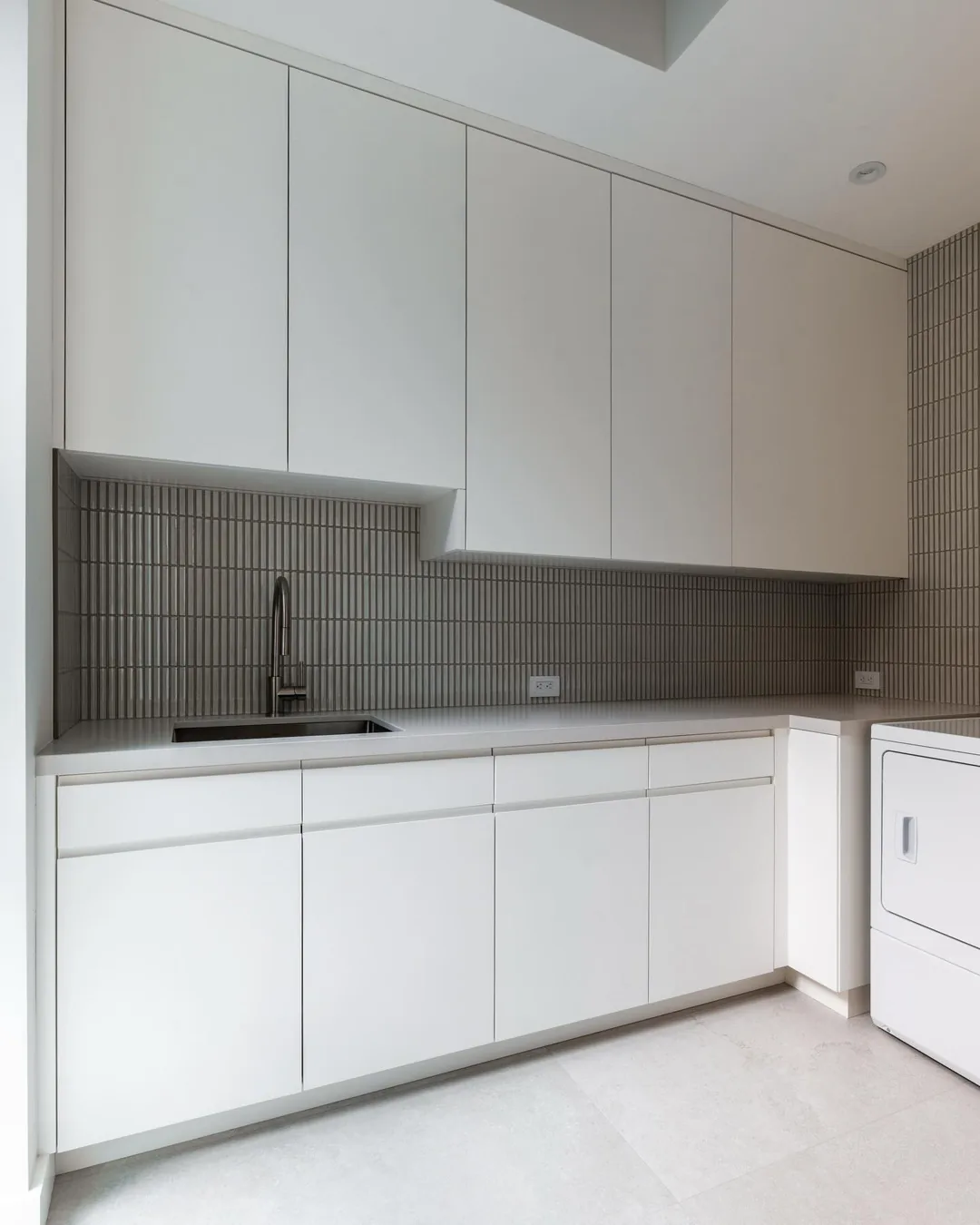
Look up in most laundry rooms and you’ll find a dusty gap above the cabinets, usually holding a box of dryer sheets someone forgot. Run the uppers all the way to the ceiling and that gap disappears.
Flat-panel doors, also called slab doors, make this look work. They have no frames or grooves, so a full wall of them reads as one calm surface.
To get it right:
- Choose matte white or soft white so a tall wall of doors feels light.
- Keep the gaps between doors thin and even.
- Save the top shelves for things you need a few times a year, like spare bulbs or extra sheets.
Here, the lower cabinets skip handles too. A slim pull channel along the top edge keeps the fronts smooth.
Upper cabinets stop short of the ceiling. The top turns into a dusty ledge for spare bottles and an empty basket, and the wall looks chopped in half.
Slab doors run all the way up in one even grid. The new top shelves hold seasonal things, and the whole wall reads as one smooth, quiet surface.
2. Matte Black Bar Pulls
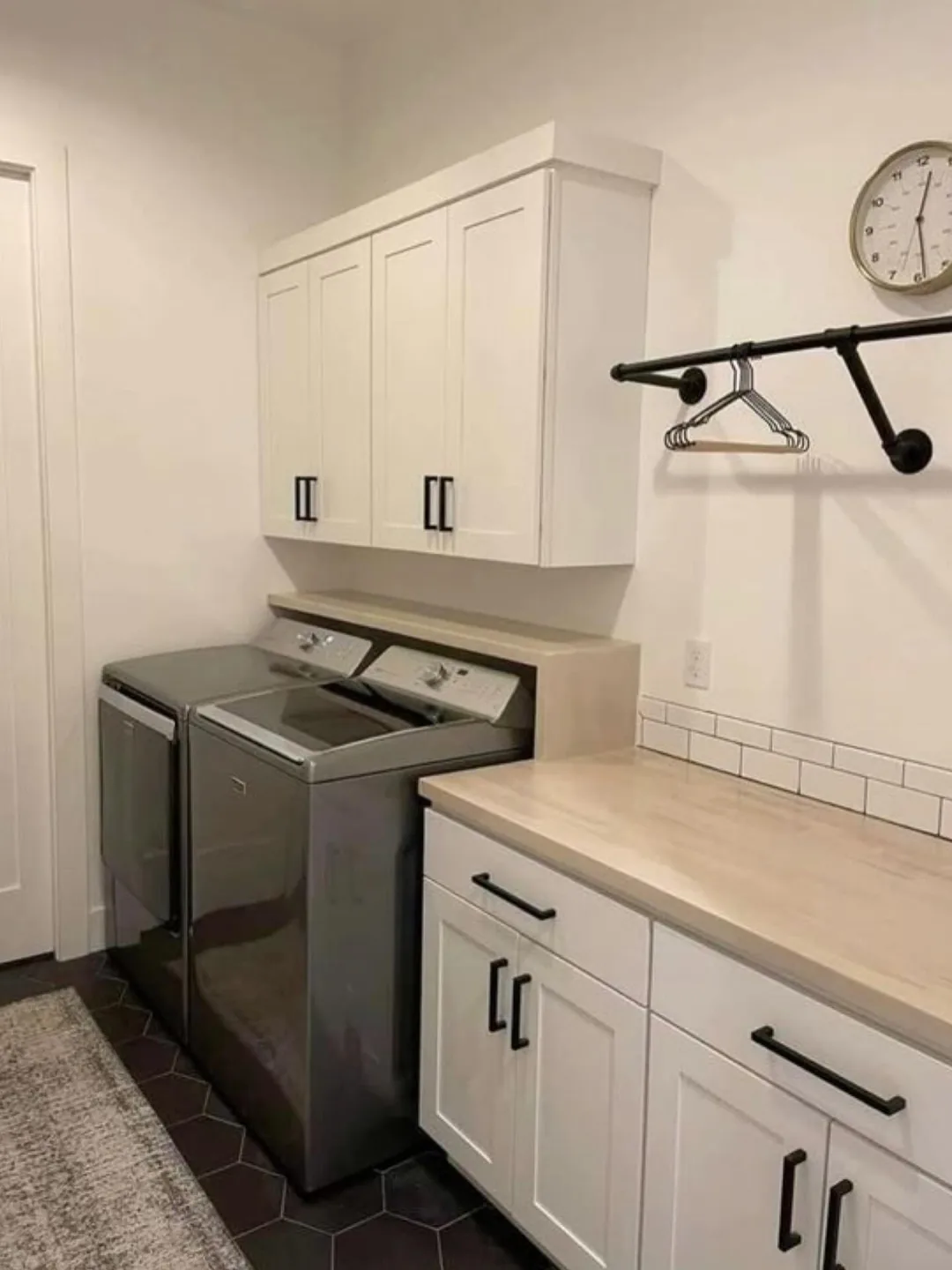
Here’s an easy rule for hardware: repeat one dark finish in at least three spots, and the room looks planned.
Matte black bar pulls are a smart place to start on white cabinets. They stand out against the paint and hide fingerprints better than shiny chrome. In this room, the black shows up again in the pipe hanging rod and the dark hex floor tile.
Where to put them:
- On upper doors, mount pulls up and down near the bottom corner, opposite the hinge.
- On lower doors, put them near the top corner.
- On drawers, run them sideways and centered, and go longer on wide drawers.
Before you shop, take a photo of your cabinet with a tape measure in the shot.
| Bar Pulls | Knobs | |
|---|---|---|
| Look | Long, straight lines that suit a modern room | Rounder and a little more classic |
| Grip | Whole hand, easy with a basket on your hip | Fingertips only |
| Install | Two holes, so measure twice | One hole, more forgiving |
| Best on | Drawers, tall doors, and wide doors | Small doors and narrow drawers |
| Good pick if | You want a crisp, modern look | You’re mixing modern with farmhouse touches |
3. A Quartz Folding Counter Over the Machines
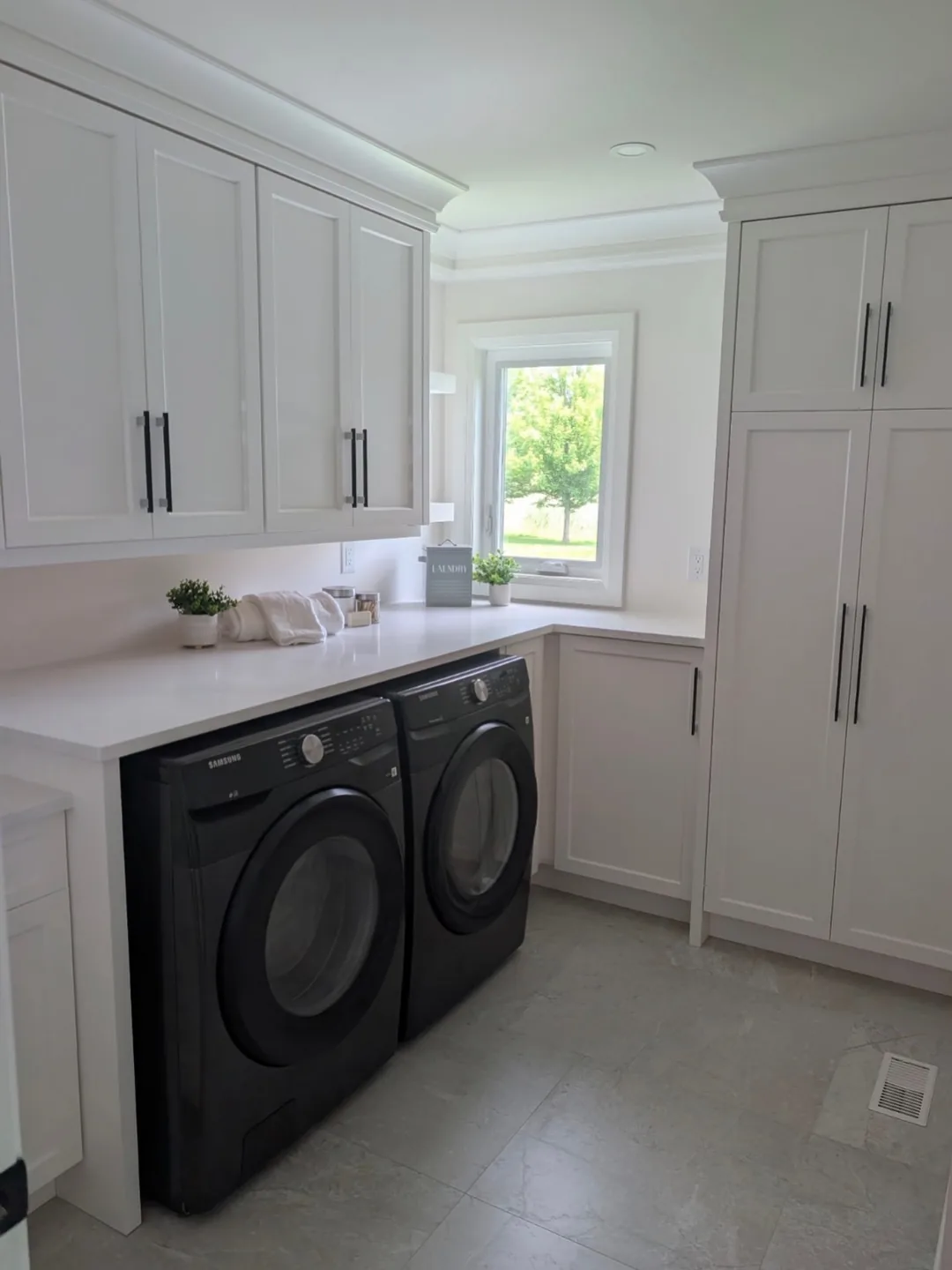
A counter right over the dryer lets you pull clothes out and fold them on the spot while they’re still warm. No more piles on the bed.
Quartz is a strong pick for a laundry room countertop. It doesn’t need sealing, it wipes clean after detergent drips, and a plain white slab keeps the room bright. In this space, it runs over black front-loaders and wraps the corner toward the window, which gives plenty of room to sort.
Plan for two things:
- A small gap above the machines so they can slide out for repairs
- Support along the back wall, since the stone spans open space
Keep the top mostly bare. A couple of small plants and a stack of folded towels are all it needs.
4. A Tall Cabinet for a Stacked Washer and Dryer
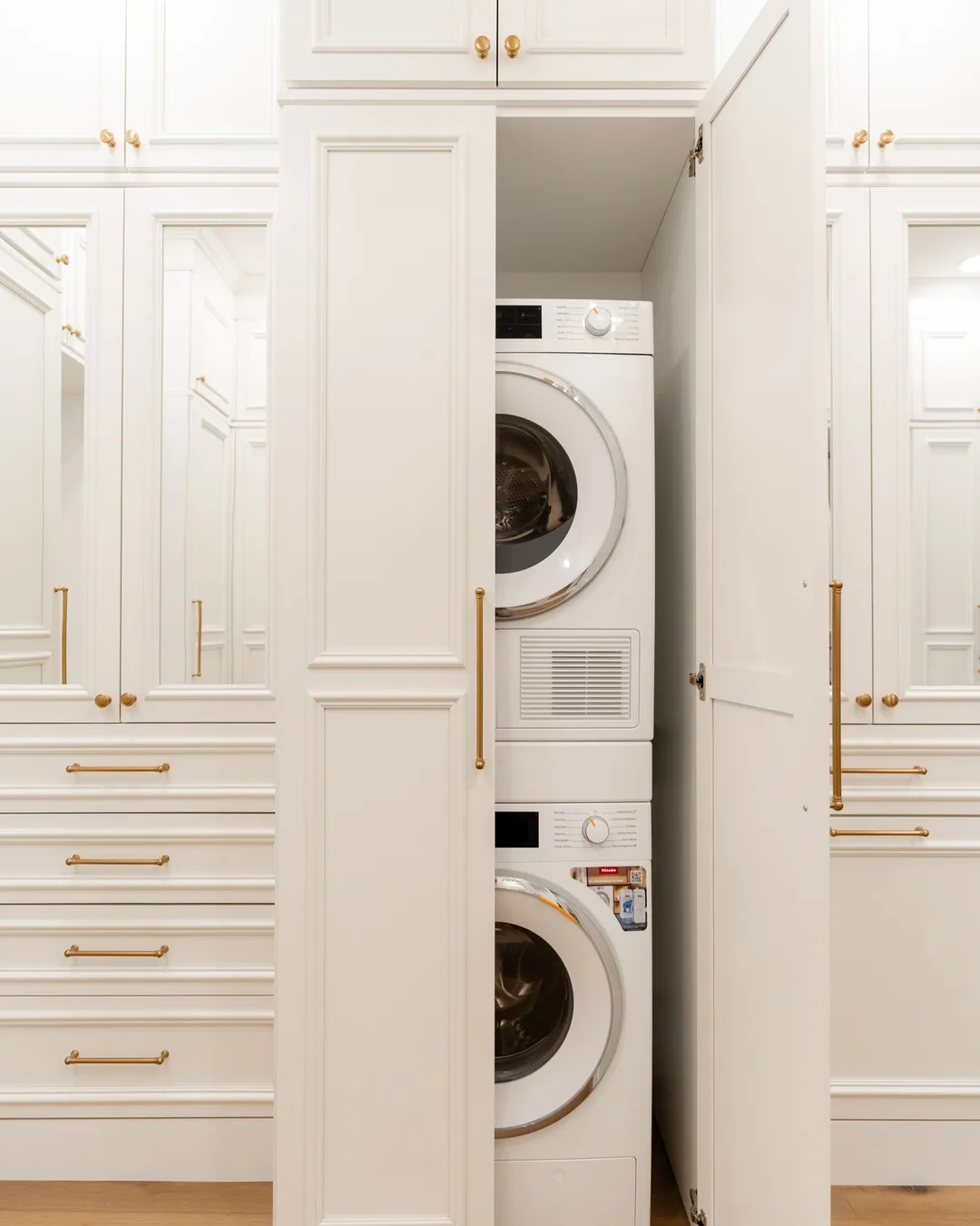
The doors in this dressing room match every other closet door around them. Open the tall middle cabinet, though, and there’s a stacked washer and dryer inside.
Putting laundry where the clothes already live saves a lot of trips down the hall. A tall cabinet makes the machines part of the built-ins instead of a big white box in the corner.
Behind the doors, this setup needs:
- A water line and a drain
- A dryer vent, or a ventless dryer
- An outlet that matches what your machines require
Match the cabinet doors and hardware to the rest of the room. Here, that means brass bar pulls. For a sleeker version, use slab doors with matte black or brushed nickel pulls.
This one is a job for a pro.
Measure the stacked machines’ height, width, and depth, then add room behind them for hoses and the vent.
Open the washer door all the way and check how far it swings. The cabinet doors and side panels need to clear it.
Find the clearance section in your machines’ manual. It lists the space needed on the top, sides, and back, so build around those numbers, not a guess.
Decide where the cabinet doors will rest while you load. Doors that fold flat or slide back into the cabinet keep the path clear.
5. A Deep Undermount Utility Sink
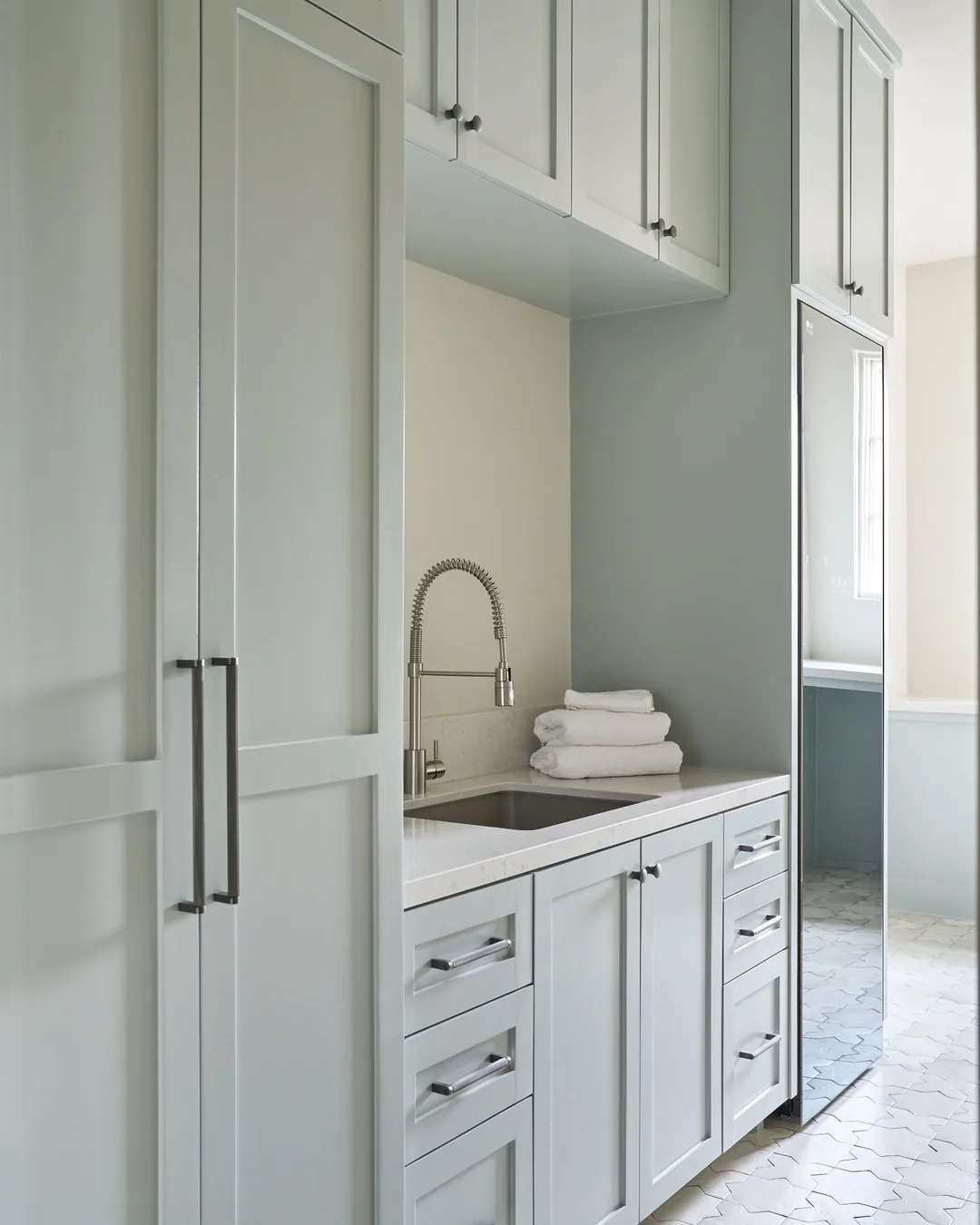
Going shallow is the most common laundry sink mistake. A small bar sink looks tidy, but it won’t fit a muddy sneaker, a paint tray, or a sweater that needs to soak.
A deep stainless sink mounted under the counter fixes that and still keeps the lines clean. With no rim on top, you can wipe spills straight into the bowl.
Pair it with:
- A tall pull-down faucet with a spring neck, like this one, so big buckets fit under it
- A sprayer head for rinsing stains and sink corners
- A drawer close by for brushes and stain spray
The soft sage cabinets show that a modern laundry room doesn’t have to be all white. Light counters and walls give the color room to breathe.
Pick one deep bowl instead of two small ones.
Keep a drain strainer in place to catch lint and loose threads.
Redo the caulk between the sink and counter when it starts to look dingy.
A drop-in sink with a rim that traps grime.
A sink across the room from the washer, so wet clothes drip a trail on the floor.
A bar sink picked only because it fits the cabinet you already have.
6. Large Porcelain Floor Tiles
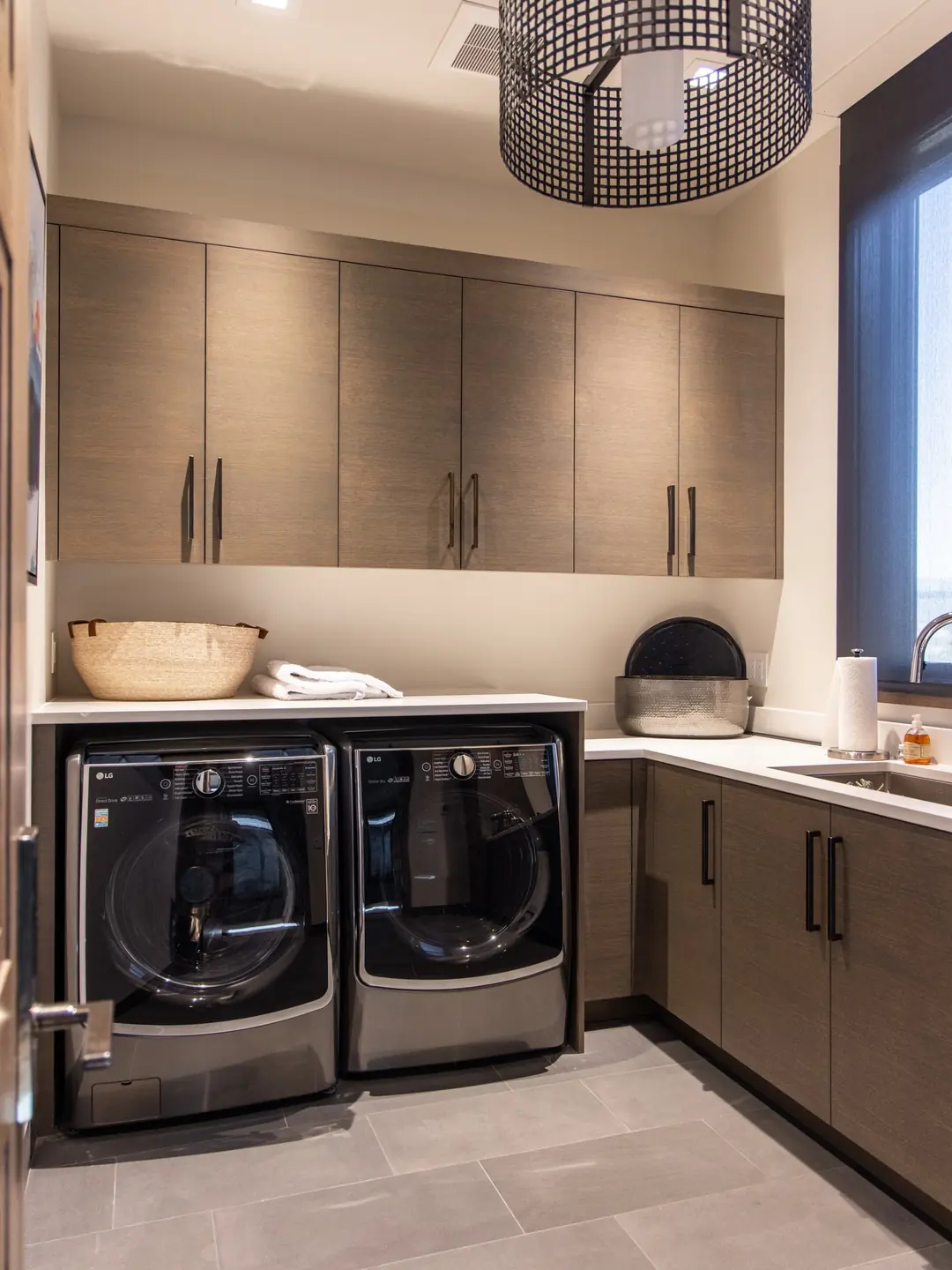
Fewer grout lines means less scrubbing on your hands and knees. That alone makes large porcelain tiles worth it in a laundry room.
Big gray rectangles like these also make a small room feel wider, because the eye has fewer lines to stop on. Porcelain handles water, dropped detergent bottles, and the weight of the machines without fuss.
A few setup tips:
- Pick a matte or lightly textured finish, since polished tile gets slippery when wet.
- Lay long tiles in an offset pattern shifted about a third of the way, not halfway. Many tile makers suggest this to keep the edges flat.
- Run the tile under the machines, not just around them.
The soft gray here sits nicely with warm wood-grain cabinets and black pulls.
💡 Quick Tip
Match the grout to the tile, not to bright white. A gray grout that blends in hides lint and detergent stains, and the floor reads as one calm surface. White grout looks crisp on day one and shows every drip within weeks.
7. A Vertical Stacked Tile Backsplash
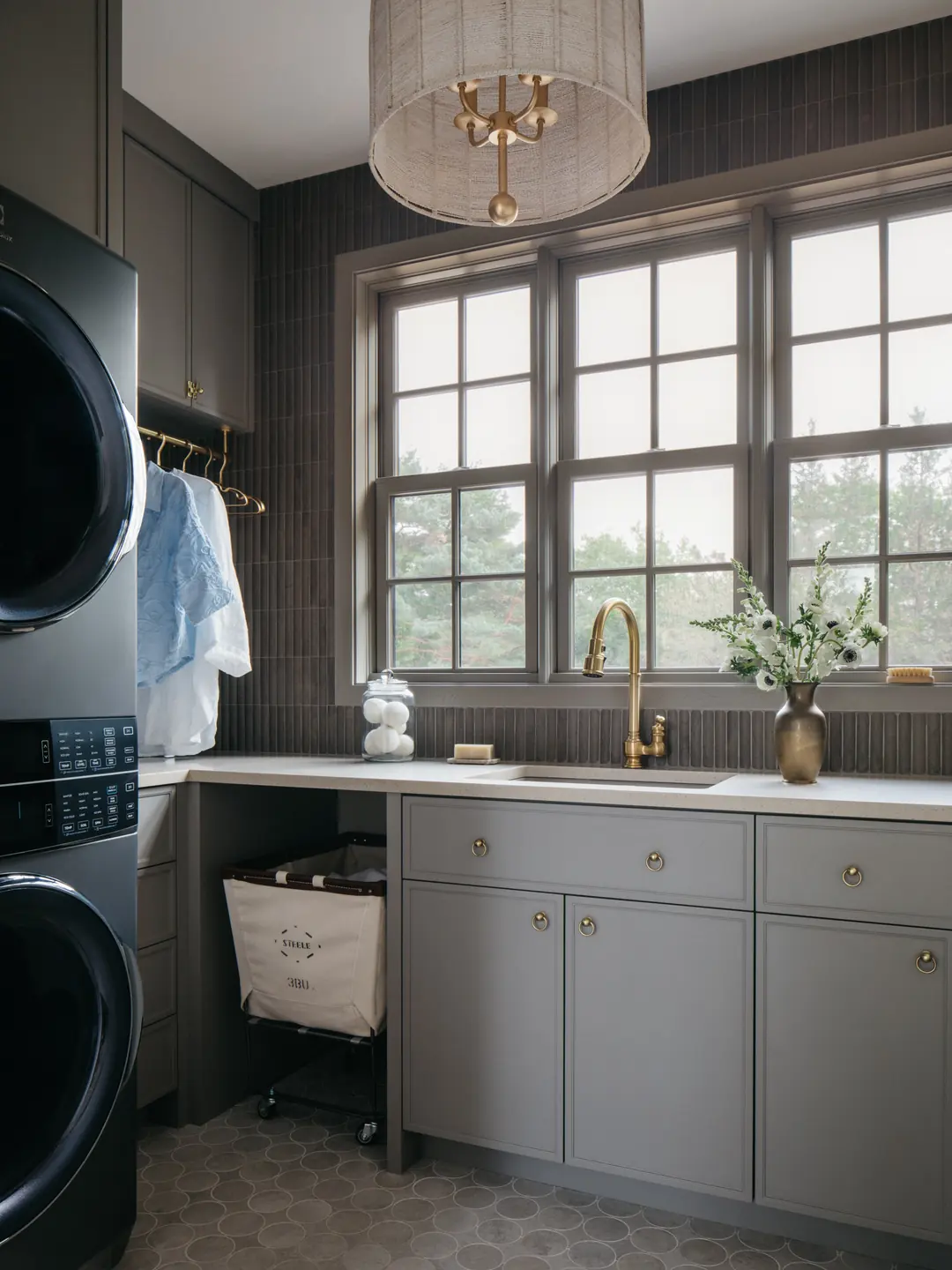
Turn a skinny tile on its end and the whole wall seems to grow taller. Stack the tiles straight up in neat columns with no offset, and you get a clean, modern grid.
This room takes the idea all the way up. Narrow dark taupe tiles climb past the window trim and finish at the ceiling, so the wall feels complete instead of busy.
Why it works:
- Straight lines match simple cabinet fronts and an undermount sink.
- A matte, slightly uneven glaze adds texture without adding pattern.
- Brass fixtures and warm gray cabinets glow against the deep color.
Ask your installer to start the layout from the center of the sink, so the columns look even on both sides.
8. Two-Tone Cabinets in Dark and Light
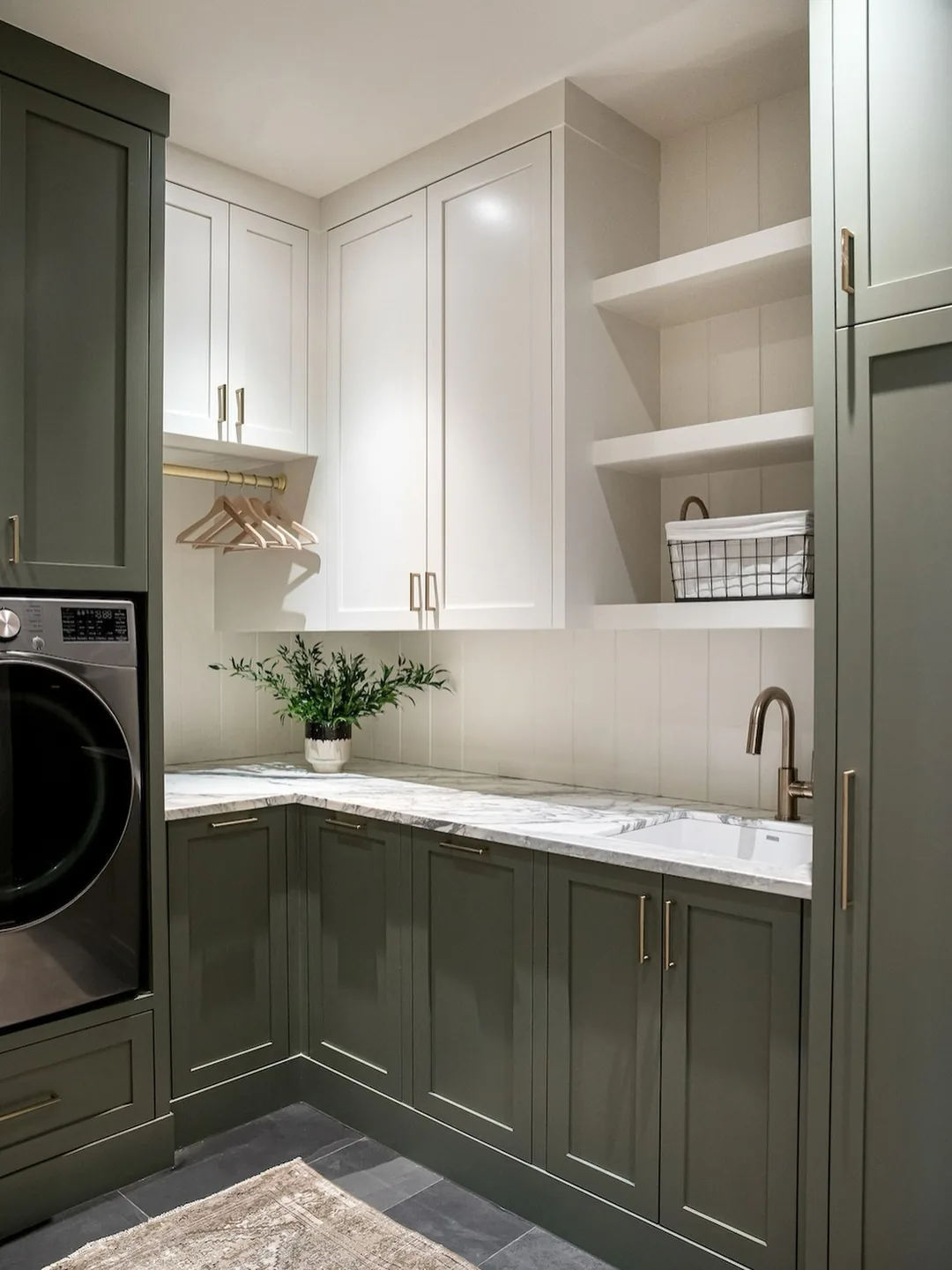
Paint the lower cabinets a deep color and keep the uppers light. That one choice grounds the room and stops a full wall of cabinets from feeling heavy.
Here, olive green covers the base cabinets and the tall pantry, while the uppers and open shelves stay soft white. The dark color sits low, where baskets and shoes cause the most scuffs, so it hides wear too.
To keep it sleek:
- Use one hardware finish on both colors. Champagne bronze pulls tie these together.
- Let the counter bridge the two. White stone with gray veins picks up both tones.
- Paint tall cabinets the darker color, so they read as part of the base.
The brass rod under the upper cabinet is a smart touch. Shirts go straight from the dryer onto wood hangers.
| Lower Cabinets | Upper Cabinets | Hardware | Feels |
|---|---|---|---|
| Olive green | Soft white | Champagne bronze | Earthy and calm |
| Navy | Bright white | Polished nickel | Crisp and fresh |
| Charcoal | Warm white | Matte black | Bold and graphic |
| Walnut wood | Matte white | Matte black | Warm and modern |
9. A Wood Slat Accent Wall
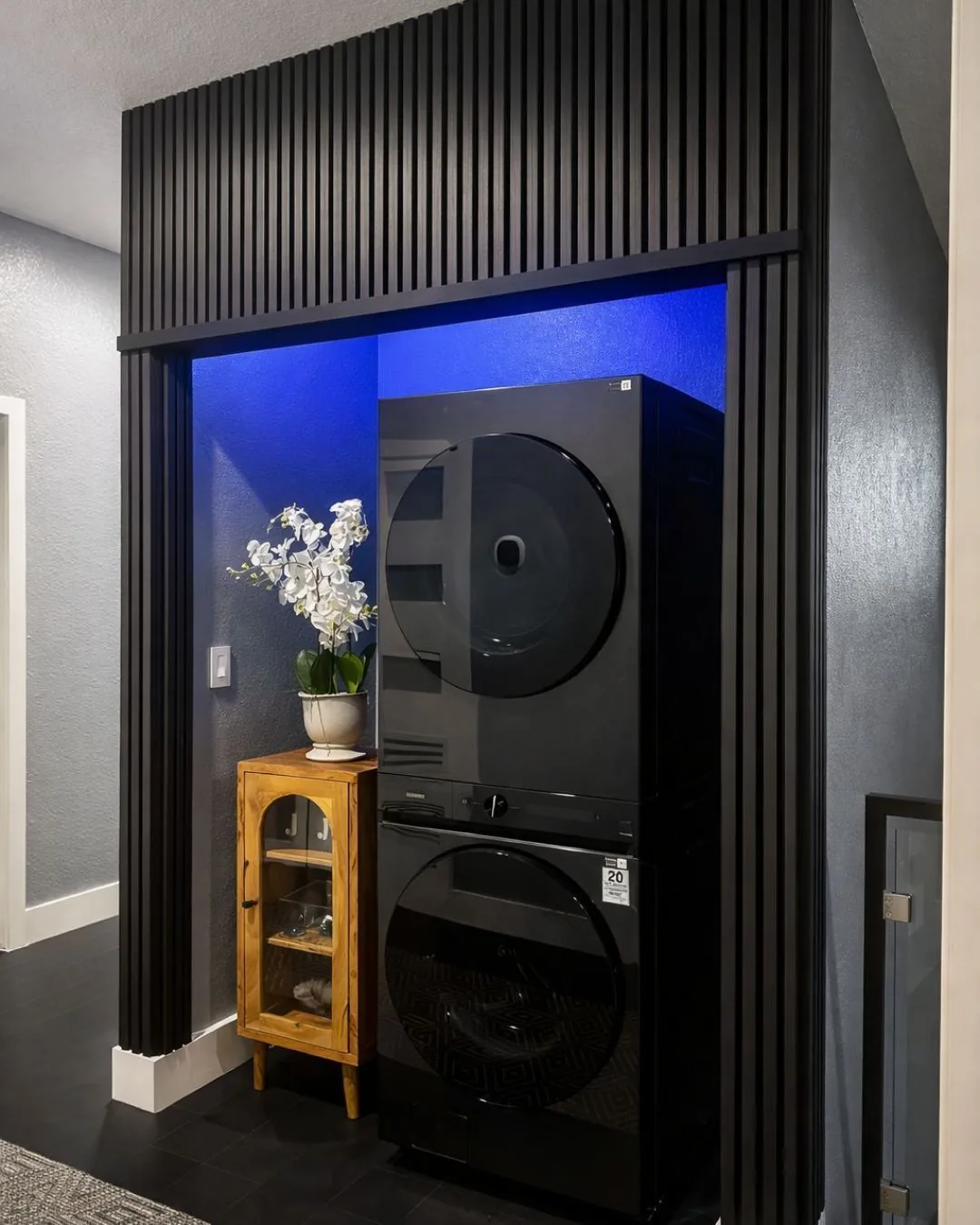
This laundry nook sits in an open hallway with no door at all. Instead of hiding the machines, black wood slats frame the opening and make it a feature.
Slat panels come in ready-made sheets, and many have a felt backing that helps soften echo. That’s handy when the washer spins down the hall from a bedroom.
How to style it:
- Run slats up both sides and across the top so the opening looks built in.
- Choose a dark slat color for dark machines. They blend together and look planned.
- Add one warm piece, like this small wood cabinet with a glass door, so the nook doesn’t feel cold.
The blue LED glow inside is a bold choice. Warm white light gives a softer, more relaxed look.
Slats should frame the nook, not box the machines in. Keep them clear of the dryer vent, and leave enough room to slide the washer and dryer out for repairs.
10. Pull-Out Hampers Behind Cabinet Doors
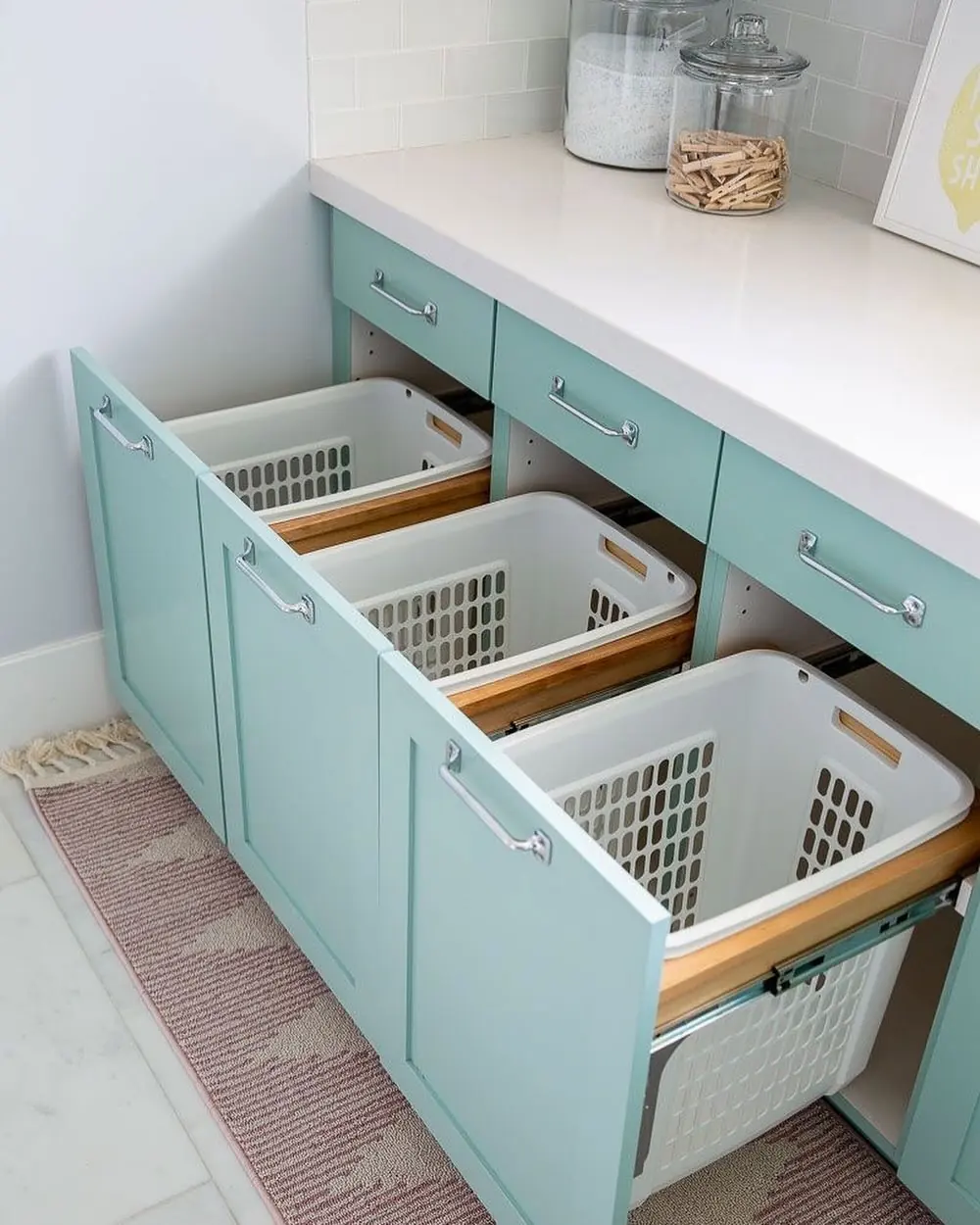
Laundry baskets on the floor can ruin a clean, modern room fast. They get kicked, they overflow, and they’re always in the way.
Pull-out hampers solve that. Each basket rides on drawer slides inside a base cabinet, so dirty clothes stay behind a door until wash day.
Make them easy to use:
- Choose baskets with handles, so you can lift one out and carry it to the washer.
- Pick full-extension slides that pull the basket all the way out.
- Put the cabinet right beside or across from the machines.
The soft aqua doors and chrome pulls keep this corner light and fresh. Up top, glass jars of powder detergent and clothespins sit on the counter, easy to reach.
Give each basket one job
11. A Fold-Down Drying Rack on the Wall
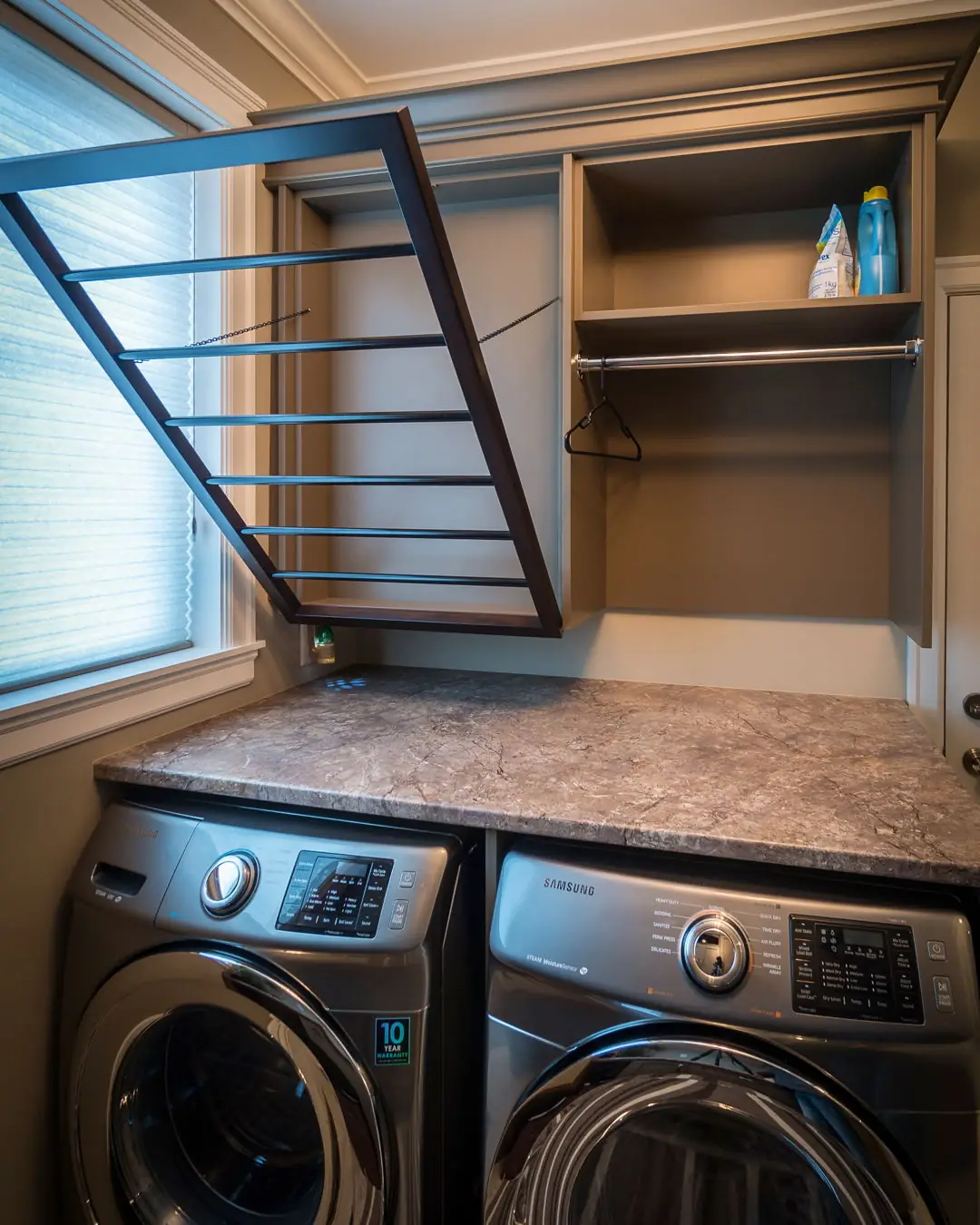
That dark wood frame tipping down from the upper cabinet is a drying rack. Fold it up, and it sits flat inside the cabinet like a door.
A built-in rack like this keeps sweaters and delicates off the floor and out of the way. Two chains hold it at an angle, and the metal rods leave space for air to move between pieces.
Plan it well:
- Put it above the counter, so drips land on the counter instead of the floor.
- Pick rods that won’t rust, like coated or stainless metal.
- Add a hanging rod in the next bay, like this one, for shirts that need hangers.
A spot by the window helps too. Crack it open on a dry day and clothes dry faster.
Sweaters hang over the dryer door and the back of a chair, and a folding rack blocks the walkway all day long.
The rack folds down when there’s a load to hang, then tucks up flat inside the cabinet. The floor stays clear, and the wall looks like plain cabinetry again.
12. A Hanging Rod Built Between Cabinets
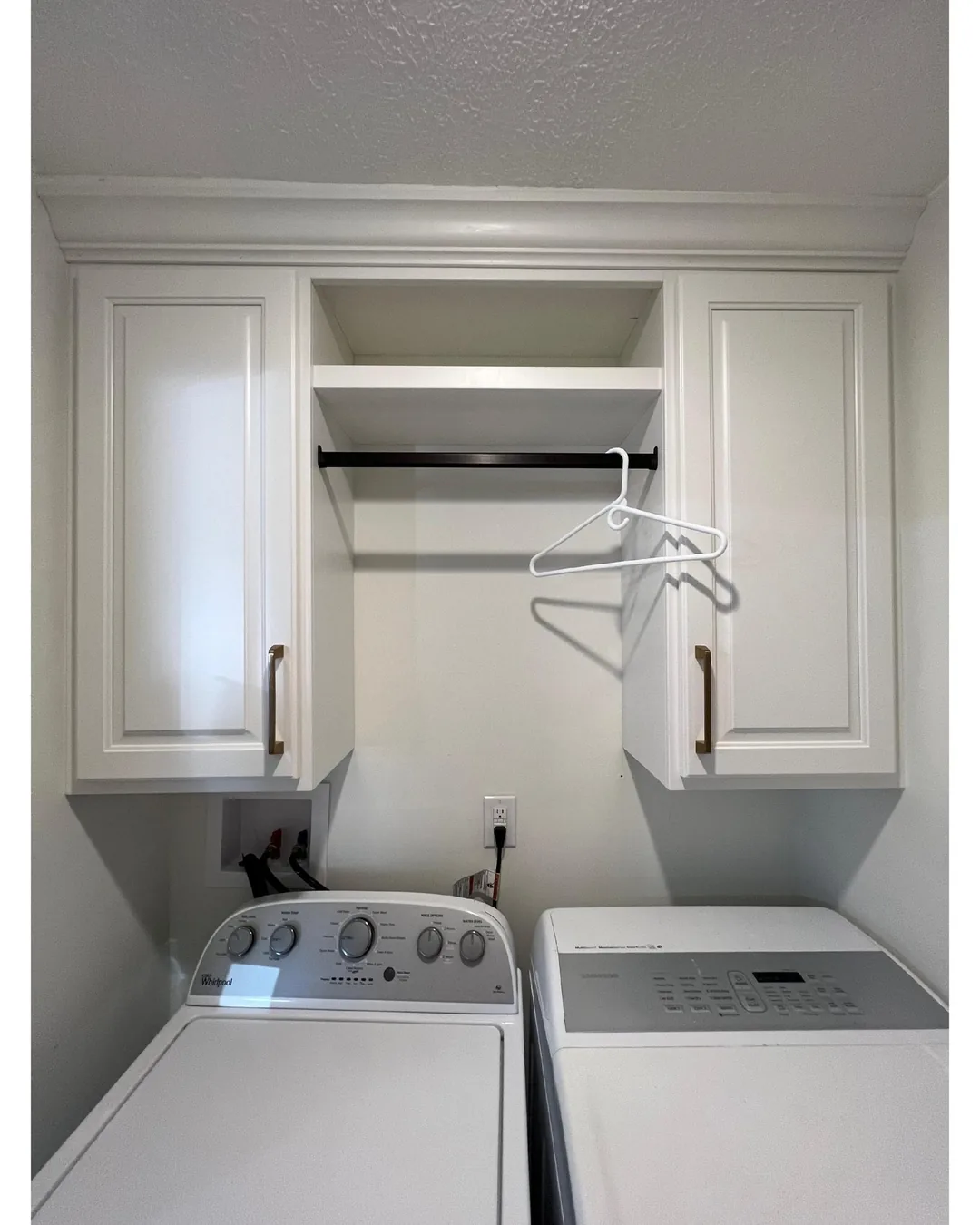
A rolling garment rack eats floor space. A rod tucked between two upper cabinets takes up none.
This setup leaves the middle bay open, with a shelf on top and a dark rod underneath. Shirts come out of the dryer and go straight onto hangers, so they don’t wrinkle in the basket.
What makes it work:
- The cabinets on each side act as sturdy ends for the rod.
- The shelf above holds spare hangers and a lint roller.
- A metal rod carries the weight of damp clothes better than a thin wood dowel.
Brass pulls on the doors bring a little warmth to an all-white wall.
⚠️ Watch Out
Top-load machines need room for the lid. Set the cabinets and rod high enough that both lids swing all the way open, and that long dresses on hangers don’t brush the machines.
13. LED Strip Lights Under the Upper Cabinets
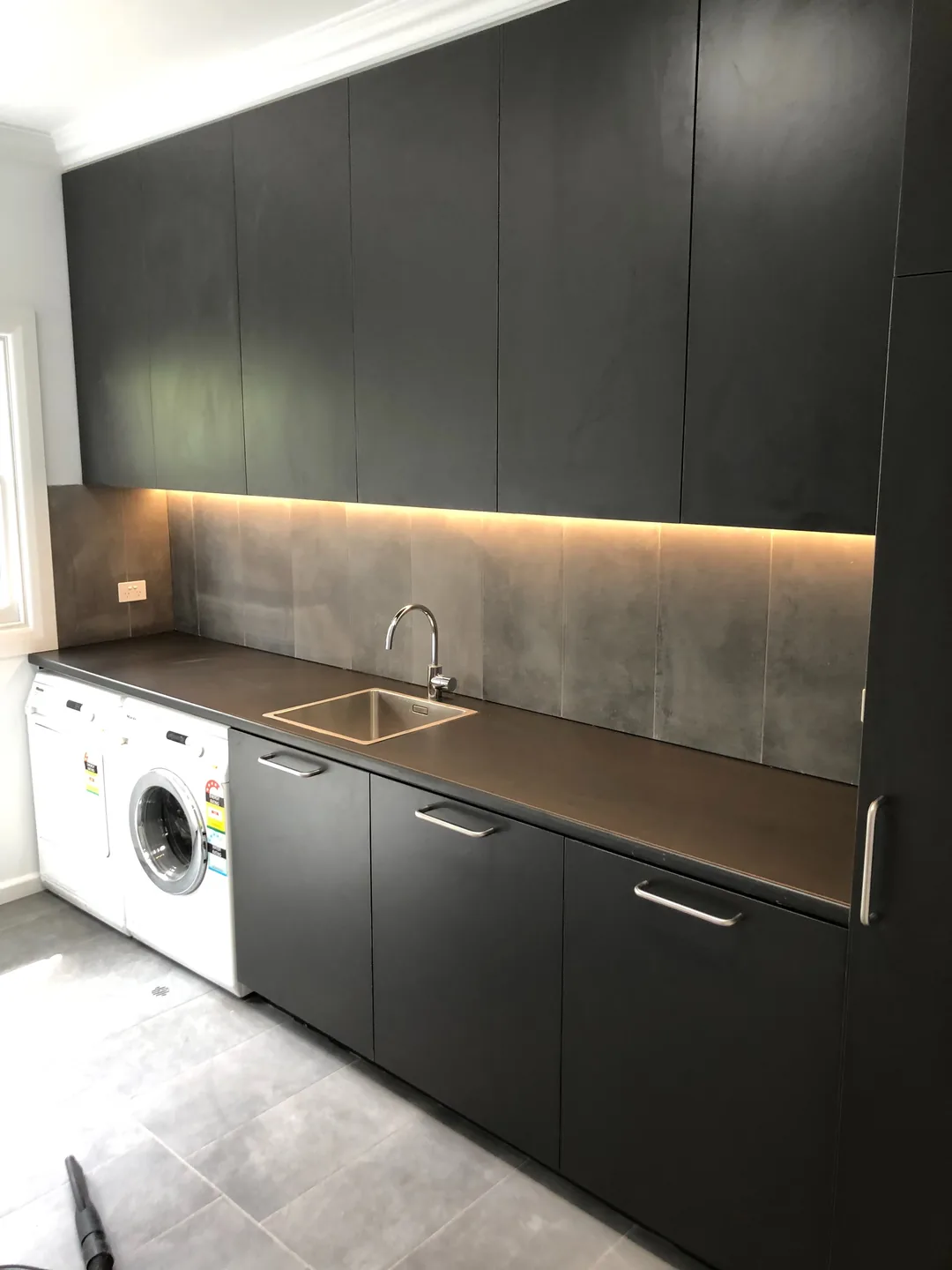
Under-cabinet lighting isn’t only for kitchens. In a laundry room, it lights the exact spot where you treat stains and match socks.
Dark upper cabinets cast a shadow on the counter below. A warm LED strip tucked underneath fixes that and makes the tile behind it glow.
Getting it right:
- Mount the strip toward the front edge, so light falls on the counter and not only the wall.
- Use a channel with a frosted cover to hide the little dots of light.
- Choose warm white. It flatters wood, stone, and concrete-look tile.
In this room, the glow is the only bright line across a wall of matte charcoal, and it makes the whole space feel finished.
14. A Slim Linear Ceiling Light
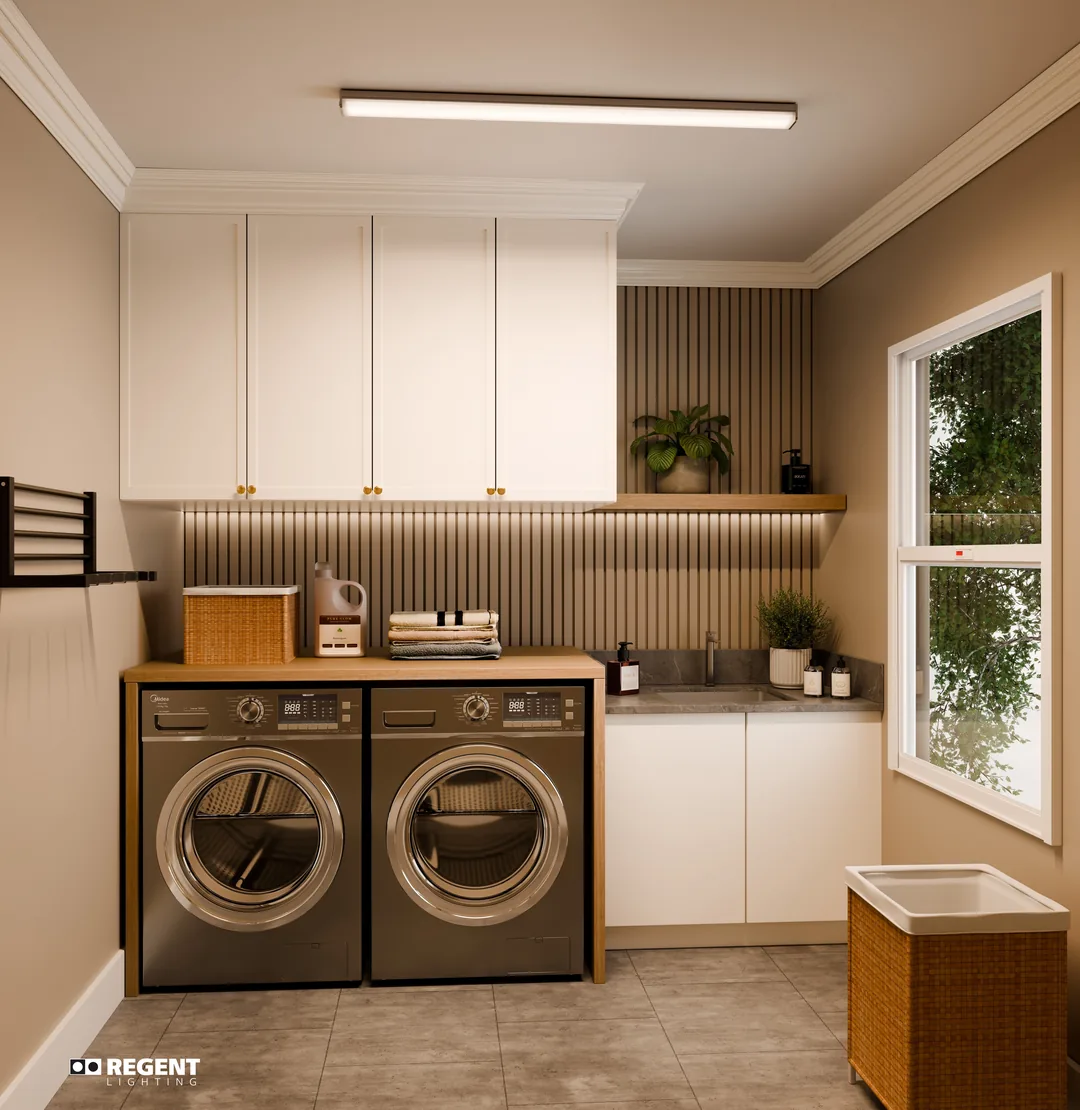
Light the whole room first, then add the extras.
A slim linear ceiling light handles that first job with almost no visual weight. It sits close to the ceiling, so it won’t crowd the crown molding or tall cabinet doors. The long shape also spreads light down the room more evenly than one small round fixture.
Here, it works with a second layer: a strip of light under the cabinets that washes down the wood slat wall and onto the counter.
Center the fixture over where you actually work, usually the machines and the folding counter, not the exact middle of the room.
- ▸Damp rating: laundry rooms get humid, so check the label before you buy.
- ▸Frosted cover: softens glare and hides the line of bulbs.
- ▸Neutral white light: shows true colors, so navy and black are easier to tell apart when you sort.
- ▸Length that fits: go longer in a long, narrow room so the far end isn’t dim.
15. Push-to-Open Cabinets with No Handles
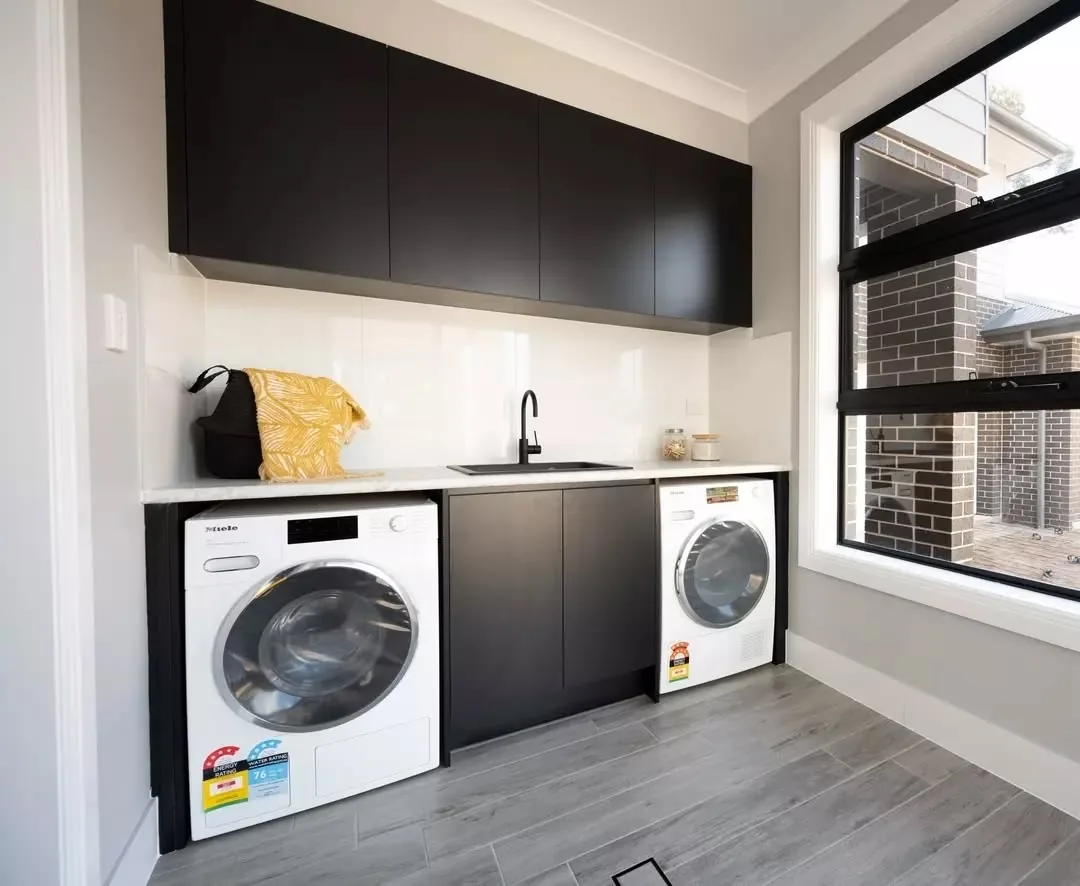
Here’s where handle-free cabinets go wrong: push latches on low doors pop open every time a hip or a laundry basket bumps them.
That’s why this room saves the sleek, handle-free look for the upper cabinets, where nothing brushes past. The matte black doors hang a little below the cabinet boxes, so you can grab the bottom edge to open them.
Why it suits a modern laundry room:
- No pulls to snag sleeves or towels
- Smooth fronts that wipe clean in one pass
- A solid dark band that frames the white backsplash
The black sink and faucet repeat the cabinet color, so the wall reads as one design.
Use push latches on upper and tall doors, out of bumping range.
Ask for hinges made for push-to-open, since regular soft-close hinges can fight the latch.
Give drawers a finger-grip edge or a groove you can hook a hand into.
Push latches on low doors right beside the machines.
Handle-free drawers for heavy detergent jugs. They’re hard to pull with no grip.
High-gloss doors if you don’t want to wipe fingerprints every day.
16. A Tall Cabinet for Brooms and Mops
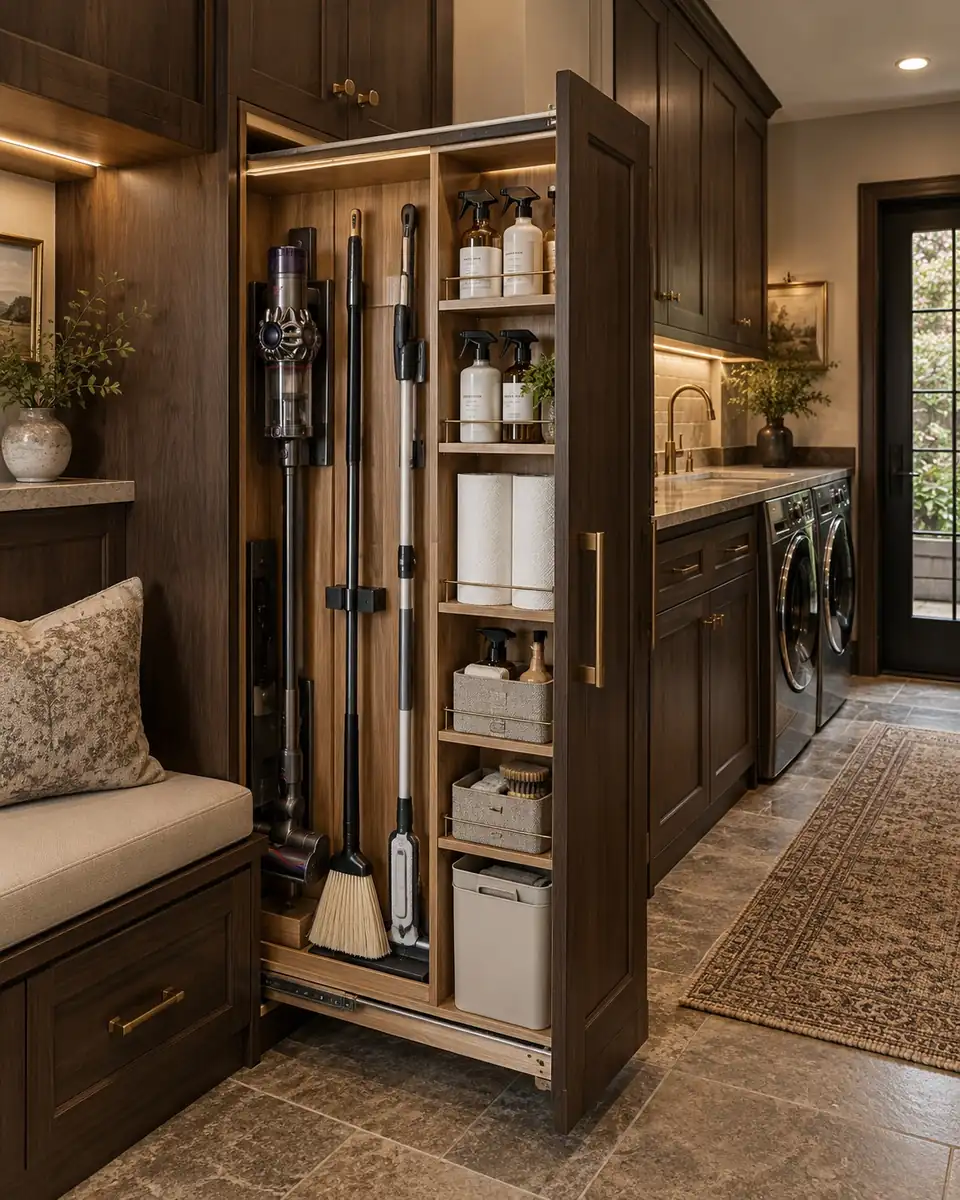
Brooms and mops are the hardest things to hide. They’re tall and awkward, and they slide sideways the second you lean them in a corner.
A tall pull-out cabinet gives each one its own spot. This one rolls out on heavy slides, with long tools clipped on one side and narrow shelves on the other.
Set yours up like this:
- Clip the broom, mop, and stick vacuum to the back panel so they hang instead of lean.
- Use shelves with low rails so spray bottles stay put when the cabinet moves.
- Add an outlet inside so the vacuum charges out of sight.
The dark walnut finish and brass pull match the rest of the cabinets, so it looks like one more door.
Before you order one
17. Reeded Glass Upper Cabinet Doors
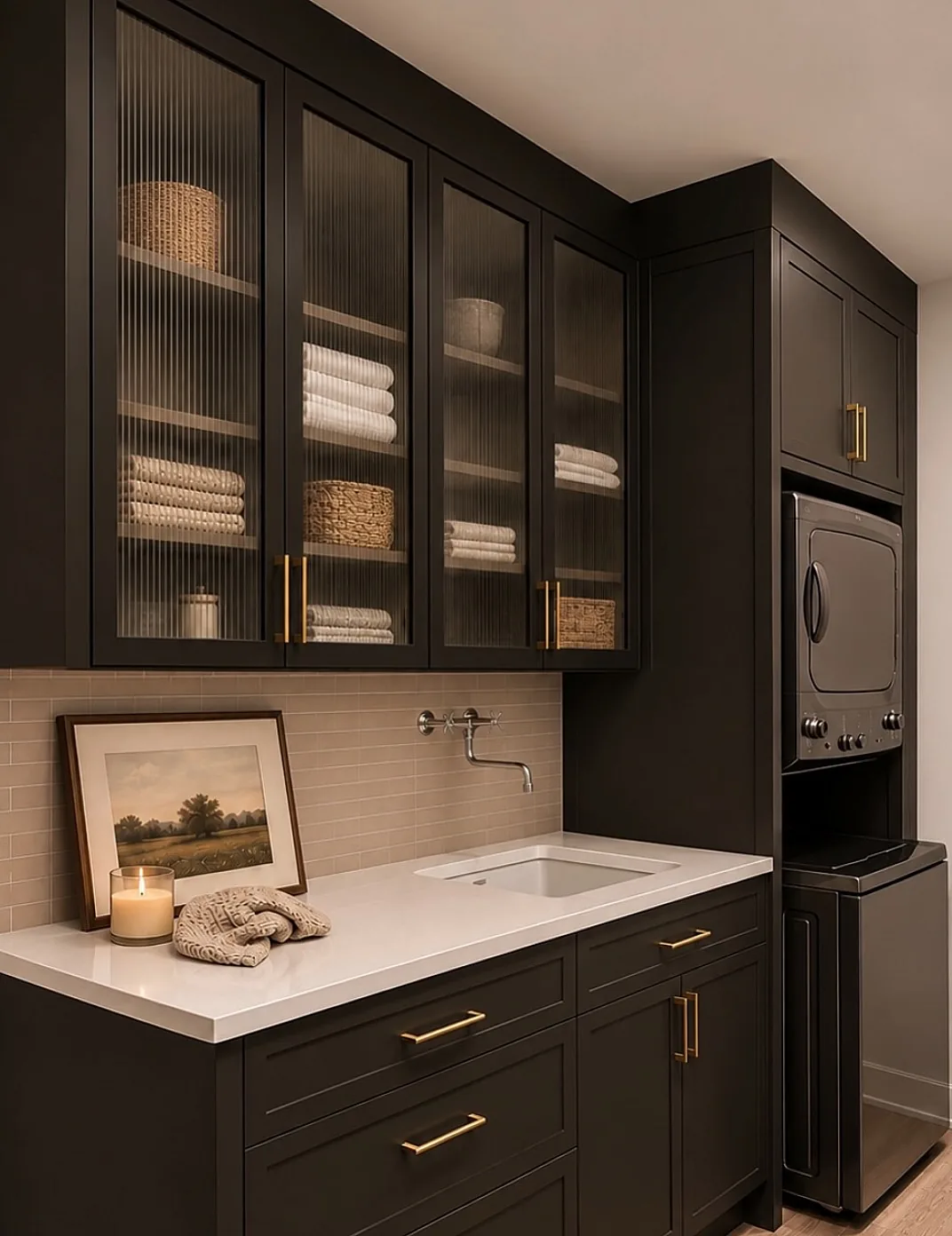
Reeded glass shows the shape of what’s inside without every detail. Towels look like soft stripes of color, and even a slightly messy shelf looks calm.
Here, the glass sits in dark espresso frames with brass pulls, and the thin vertical ridges echo the tall lines of the cabinets.
What to keep behind it:
- Folded towels in two or three soft colors
- Woven baskets for small, messy things like clothespins
- One or two simple pieces, like a stone bowl
Save solid doors for detergent jugs and cleaning sprays. Bright labels show through, even behind ribbed glass.
The wall-mounted faucet is a nice touch, too. It keeps the counter behind the sink clear and easy to wipe.
18. A Laundry Closet Behind Sliding Doors
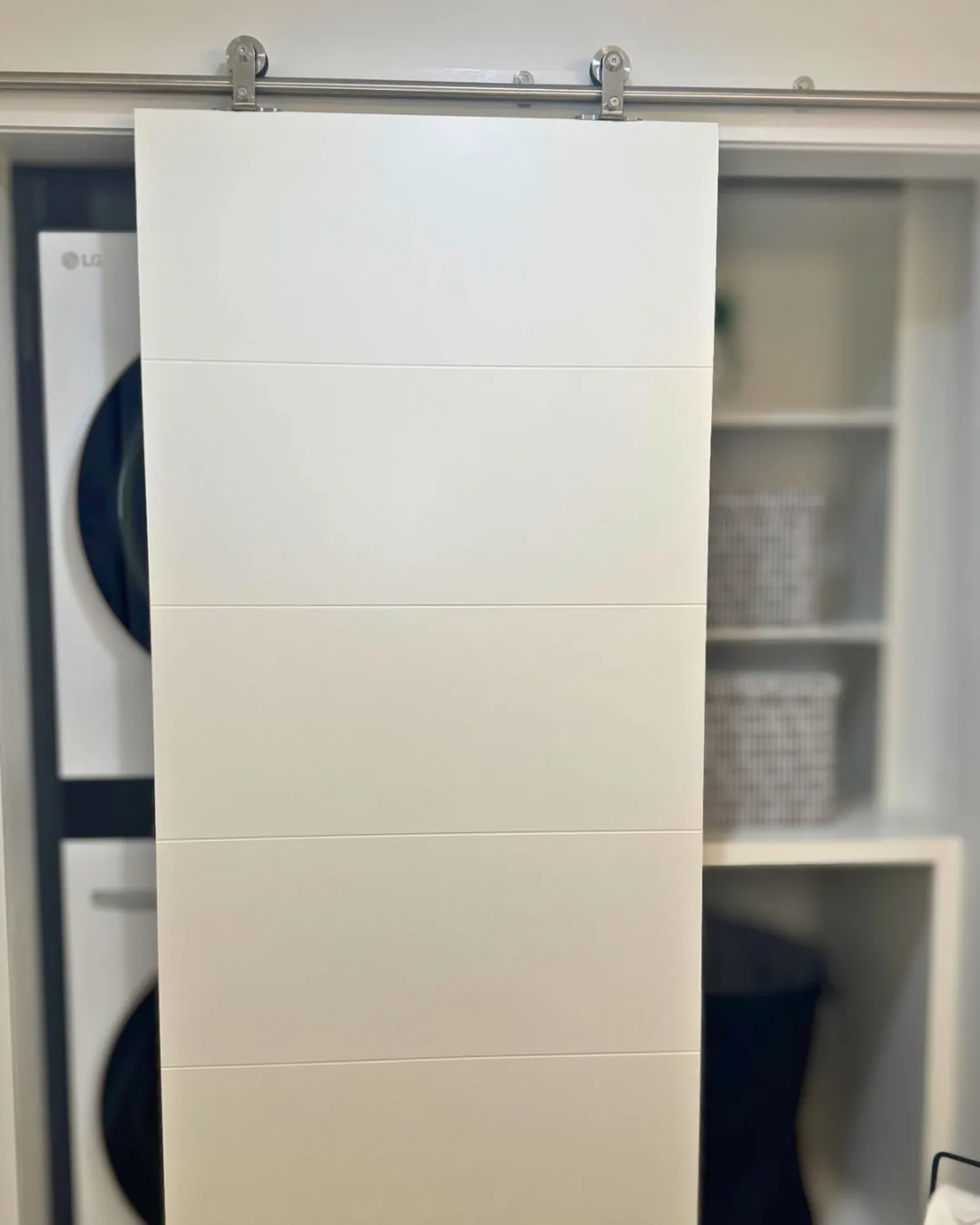
Sliding doors don’t have to look like a farmhouse barn. This one is smooth white with thin horizontal grooves, hung on a brushed steel rail with round wheels.
Slide it left, and the shelves of baskets appear. Slide it right, and you reach the stacked washer and dryer. Close it, and the hallway looks calm again.
Why a slider works here:
- It needs no swing space, so it fits tight halls.
- One wide door can cover most of a closet.
- The rail turns into a sleek detail instead of plain hardware.
Match the rail finish to the door handles or light fixtures nearby, so the steel feels planned.
Measure the closet opening and pick a door a little wider, so no gap shows at the edges when it’s closed.
Check the wall above for solid backing. The rail carries the full weight of the door.
Make sure the wall where the door slides is clear of light switches, art, and outlets.
Add a floor guide at the bottom, so the door glides straight and doesn’t swing out.
19. Open Shelves with Matching Bins
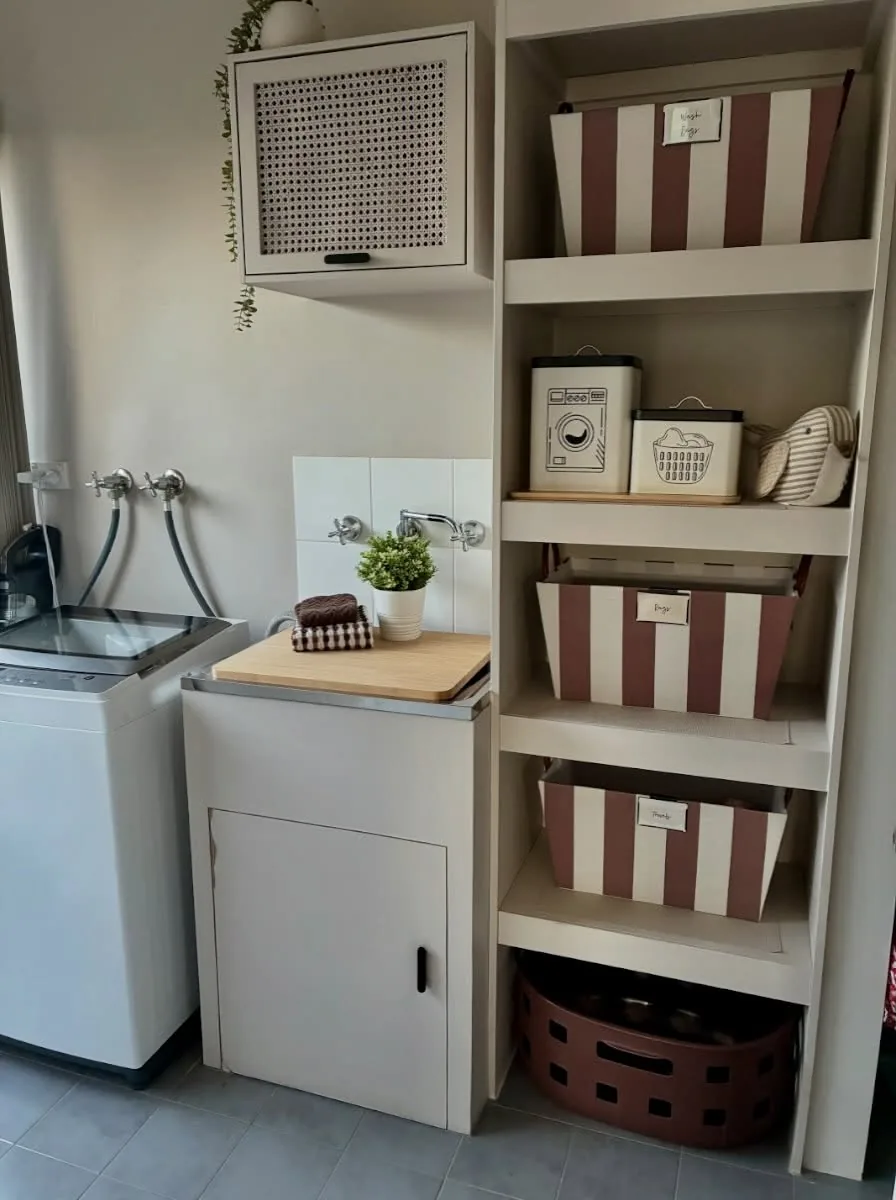
Open shelves only look tidy when the things on them match. Mix five kinds of baskets, and the shelf looks busy. Repeat one, and it looks planned.
This tall unit sits beside a laundry tub and uses the same striped bins on three shelves, each with a small white label. Two lidded canisters fill the middle shelf, and a sturdy basket on the floor holds the heavy stuff.
Keep it sharp:
- Choose one bin style and buy them all at once.
- Label the fronts, so nobody has to dig.
- Leave a little space above each bin so it slides out easily.
For a sleeker version, swap the stripes for solid white, gray, or black bins.
20. A Built-In Ironing Board Drawer
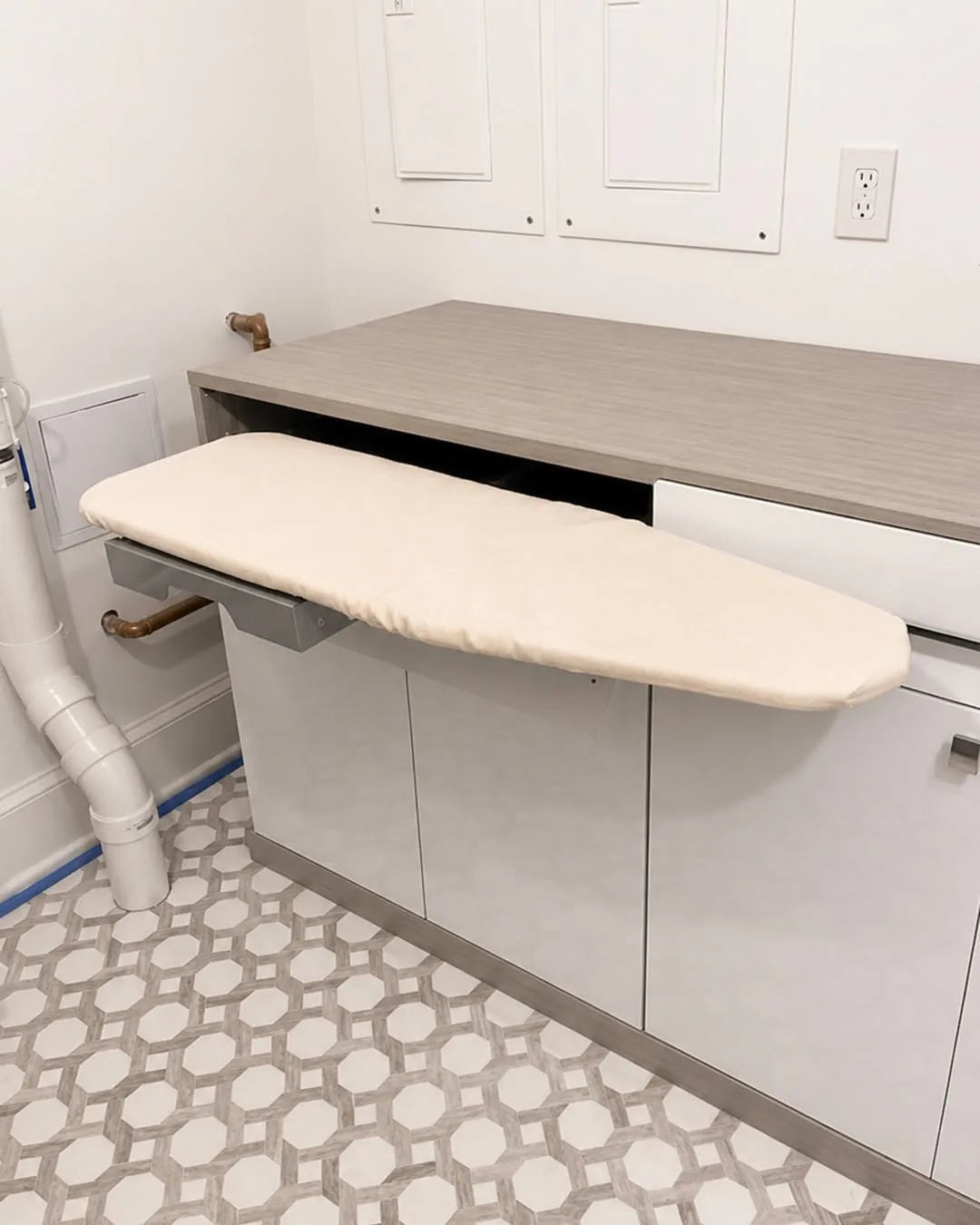
Most ironing happens in a rush: one shirt, right before you walk out the door. Dragging out a full-size board for that feels like too much.
A built-in ironing board hides in what looks like a regular drawer. Pull it out, swing the board into place, and it’s ready. Push it back, and the cabinet front matches the others.
This one tucks under a gray wood-look counter, above glossy white doors. Look for:
- A board that swivels, so you can stand at a comfortable angle
- A heat-resistant cover that’s easy to replace
- An outlet close by, so the iron cord doesn’t stretch across the room
It’s made for quick touch-ups. For a whole pile of shirts, a full board is still easier.
📌 Good To Know
A drawer board is usually smaller than a freestanding one, and its height is set by the drawer. Stand at the cabinet before you build it in and make sure that height won’t leave you hunched over.
21. Pedestal Drawers Under Front-Loaders
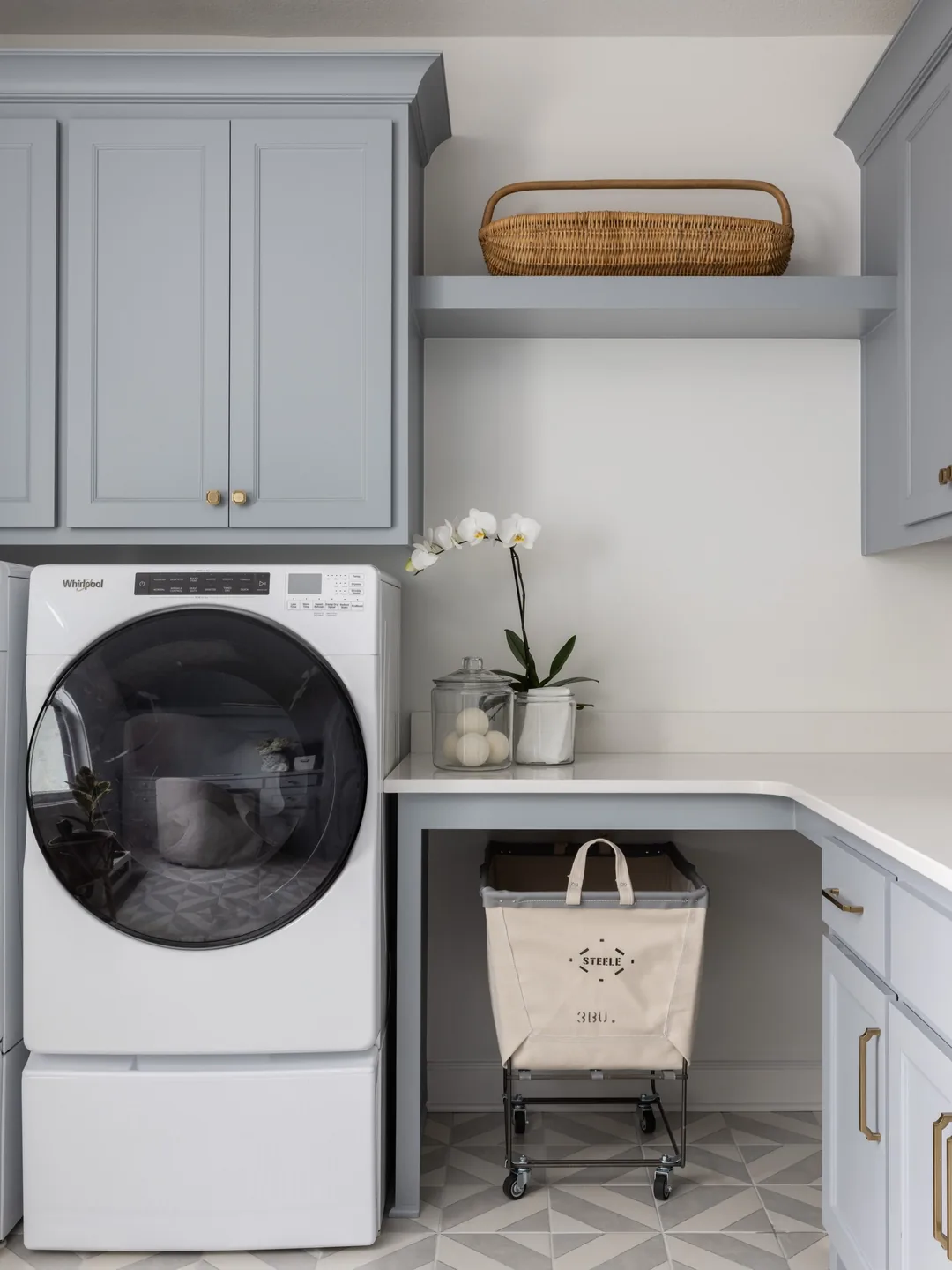
Raise the washer onto a pedestal drawer, and you stop bending to the floor for every load. The door sits closer to waist height, which is easier on your back.
The drawer underneath adds hidden storage, too. It’s a good home for things you want near the machine but not on display:
- Spare wool dryer balls and dryer sheets
- Mesh bags for delicates
- A stain stick and a lint roller
Here, the white pedestal matches the white washer, so the two look like one tall unit. Next to it, the counter leaves an open space underneath where a rolling canvas cart can park.
Buy a pedestal made to fit your exact washer and dryer. A base that doesn’t match can wobble during the spin cycle, which is hard on the machine and the floor.
22. A Pet Washing Station Next to the Laundry
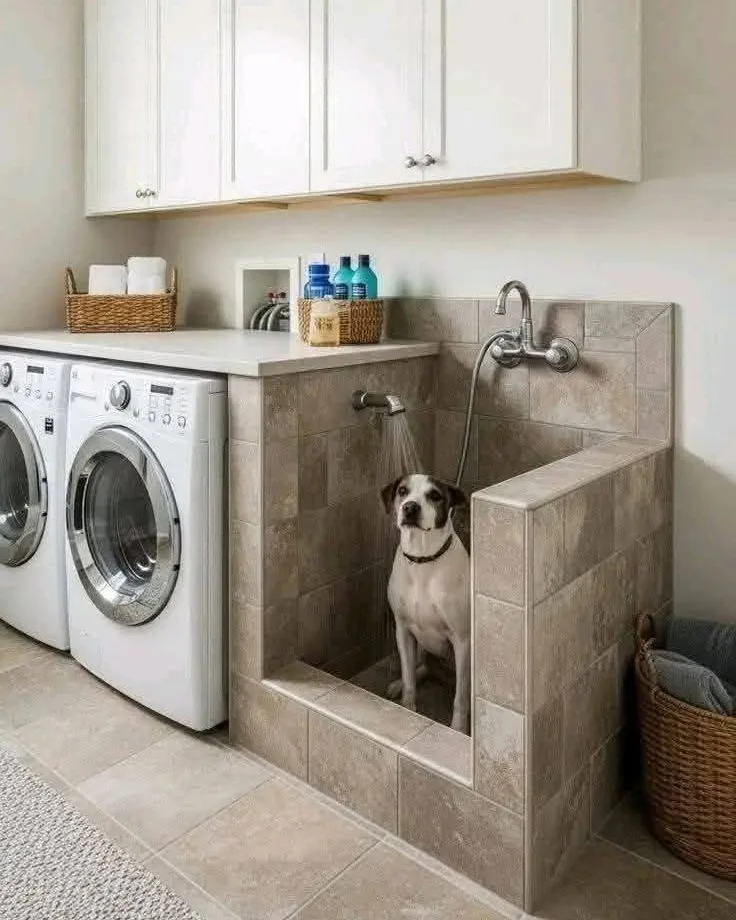
After a rainy walk, muddy paws usually head straight for the nearest rug. A pet washing station next to the laundry stops them at the door.
This one is a low tiled basin with half walls, so the dog walks in instead of being lifted. A wall spout fills buckets, and a handheld sprayer on a hose reaches every leg.
Make it practical:
- Use the same stone-look tile as the floor, in a matte finish so paws don’t slip.
- Keep shampoo in a basket on the counter, just out of splash range.
- Stack old towels in a basket beside the basin.
Wet towels go straight into the washer a few steps away.
| Raised Tub | Floor-Level Basin | |
|---|---|---|
| Best for | Small and medium dogs | Large or older dogs who can walk in |
| Your back | No bending, but you lift the dog in | No lifting, but you kneel or bend |
| Splashes | Easier to keep inside the tub | Needs half walls or a curb |
| Space | Takes a cabinet-sized spot | Takes a small corner of floor |
| Plumbing | Water line and a drain | Water line and a drain |
23. A Bench and Hooks for a Laundry Mudroom
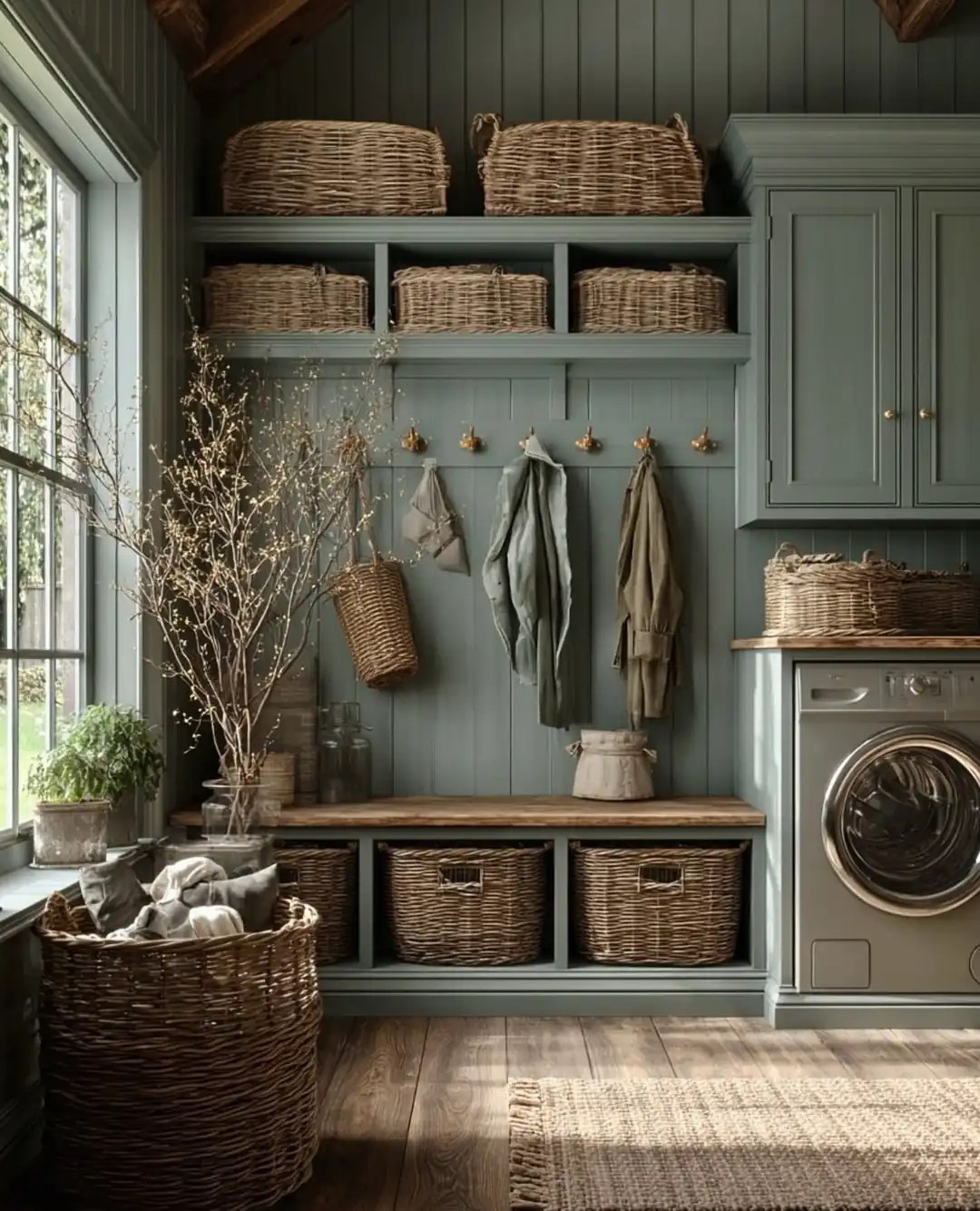
A mudroom and a laundry room handle the same mess from two ends. One catches muddy coats and bags, and the other cleans them. Put both in one room, and you save a lot of walking.
This corner pairs a built-in bench with a row of hooks, painted the same soft sage as the cabinets beside the washer. Cubbies sit under the bench and above the hooks, each with its own basket.
To keep it looking sleek:
- Paint the bench, wall paneling, and cabinets one color, so they read as one built-in.
- Give the bench a wood top, which handles bags and scuffs better than paint.
- For a more modern feel, swap woven baskets for solid fabric bins in one neutral.
24. A Clean, Modern Basement Laundry
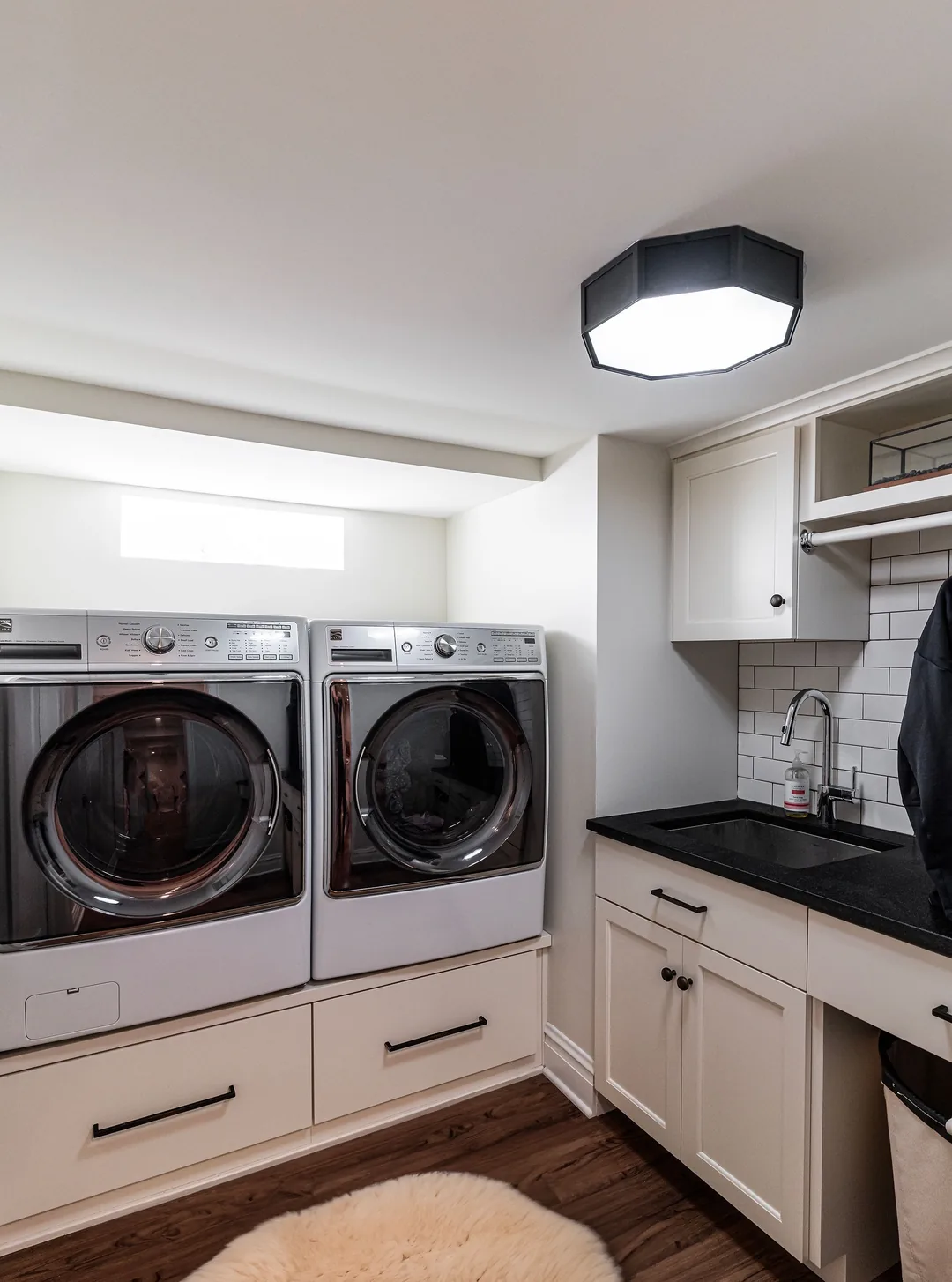
Most basement laundry rooms feel gloomy for one reason: they’re lit like storage rooms, with one bare bulb and nothing else.
This basement does the opposite. A black flush-mount light sits close to the low ceiling, and the walls, cabinets, and tile stay white to bounce light around. Even the small window high on the wall is left uncovered.
Other smart choices here:
- Wood-look flooring instead of real wood, since basements can run damp
- A black counter and sink that hide stains between cleanings
- A rod over the sink for drip-dry pieces
A soft rug in front of the machines makes a cool basement floor nicer under bare feet.
Before you finish a basement laundry
Start With the Spot That Bugs You Most
A modern laundry room isn’t about having the newest machines. It’s about giving everything a place, so the counters stay clear and the lines stay clean.
You don’t need all 24 ideas at once. Start with your biggest daily annoyance. Maybe it’s the mop sliding down the wall, the clean shirts wrinkling in the basket, or the dim light over the sink. Fix that first, then add one finish at a time.
Save these modern laundry room ideas to your laundry room board, so they’re ready when you plan your next update.