


This lemon balm recipe for weight loss takes 12 minutes and uses five simple ingredients: lemon balm, hot water, ginger, lemon, and optional honey. It is a calming, caffeine-free tea with about 10 calories a cup (without honey). It won’t burn fat on its own, and no human trial has shown that lemon balm causes weight loss.
What it can do is replace a sugary drink and give you a relaxing evening habit. That swap is the realistic way it might help. Below you’ll find the full recipe, the benefits people actually have reason to expect, what the research does and doesn’t show, the “natural Ozempic” claim, how it compares with other teas, and who should be careful.
What Is Lemon Balm?
Lemon balm (Melissa officinalis) is a lemon-scented herb in the mint family. Like other mints, it spreads fast in a garden or pot. People have brewed the leaves for centuries, mostly for relaxation, sleep, and mild stomach upset such as bloating and gas. Weight loss is a very recent addition to that list.
The leaves contain plant compounds like rosmarinic acid, flavonoids, and terpenes. These give the herb its citrus smell. Plain lemon balm leaf tea has no caffeine.
You will see lemon balm sold in many forms: fresh leaves, dried leaves, tea bags, capsules, tinctures, powders, and specialized supplements. These are not interchangeable. A cup of tea delivers a much smaller and less predictable dose than a standardized extract, and that difference matters for everything you read about the herb’s effects.
How It May Support Weight Loss
Lemon balm may support weight loss indirectly through stress control, better sleep, digestion, and blood sugar balance. Chronic stress can raise cortisol, which is linked to overeating and belly fat. Lemon balm may also help reduce anxiety and improve sleep, potentially helping with stress eating and late-night cravings. Some studies suggest it may support healthy blood sugar, cholesterol, and triglyceride levels, although these effects appear modest.
Lemon Balm Tea Recipe for Weight Loss (with Ginger, Lemon and Honey)
Ingredients
Equipment
Method
Notes
- Use 1 tablespoon of dried leaves or 2 tablespoons of fresh leaves per cup. Fresh leaves give a brighter lemon aroma.
- Drink it daily as part of a balanced diet and an active lifestyle.
- Honey adds most of the calories. Use less honey, or skip it, for a lighter drink.
- This tea supports a healthy routine but does not burn fat on its own. It works best as a swap for sugary drinks.
- Check with a doctor before using lemon balm regularly if you are pregnant, take thyroid medication, or take sedatives.
Does Lemon Balm Make You Lose Weight?
No human trial has shown that lemon balm tea directly causes weight loss. Human research has mainly looked at related markers such as blood sugar, cholesterol, and triglycerides, and most studies used concentrated supplements rather than tea.
Animal studies have shown more promising results. Some mouse and rat studies found less weight gain and visceral fat after lemon balm extract, but these findings cannot be directly applied to humans because the studies used small groups and concentrated extracts.
Bottom line: Lemon balm tea may fit into a weight-loss routine as a low-calorie drink, especially as a swap for sugary beverages. However, it should not be considered a fat-burning treatment or a replacement for a balanced diet, regular movement, and good sleep.
Lemon Balm Tea Recipe for Weight Loss
This version adds ginger, lemon, and a little honey for flavor. None of these is a fat burner. They just make a plain herbal tea taste better.
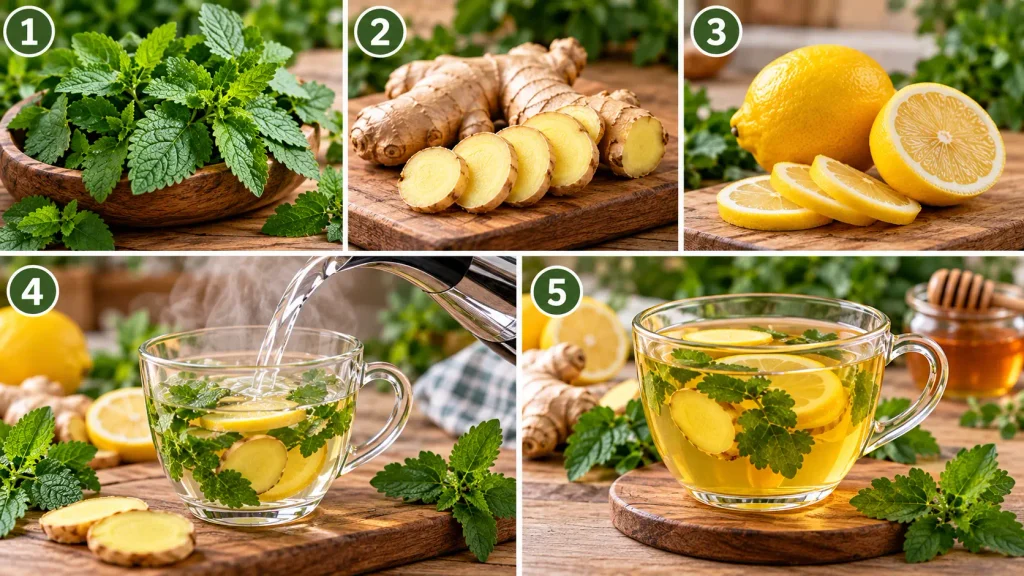
Ingredients
- ¼ cup loosely packed fresh lemon balm leaves (or 1 tablespoon dried)
- 1 cup hot water, just off the boil
- ½-inch piece of fresh ginger, grated (or ½ teaspoon ground ginger)
- Juice of ½ lemon
- 1 tablespoon honey (optional)
Instructions
- Gently bruise the fresh leaves with your fingers or the back of a spoon to release their flavor.
- Put the lemon balm and ginger in a mug. Pour the hot water over them.
- Cover the mug and steep for 10 minutes. Covering keeps the aroma from escaping.
- Strain out the leaves and ginger.
- Stir in the lemon juice. Add honey only if you want it.
- Drink it warm, or let it cool and pour it over ice.
Tips for a Better Cup
- Use water just off the boil rather than a hard, rolling boil. It keeps the flavor fresh and less grassy.
- Add the lemon juice at the end. Steeping it with the leaves can make the tea taste sharp.
- Harvest or buy leaves that smell strongly of lemon. Dull, brown, or musty dried leaves make a flat tea.
- Store dried lemon balm in an airtight jar away from light and heat.
Fresh vs. Dried Lemon Balm
Dried leaves are more concentrated, so you need less by volume. Fresh leaves taste brighter and lighter. Dried leaves taste deeper and earthier.
| Hot water | Fresh lemon balm (loosely packed) | Dried lemon balm |
|---|---|---|
| 1 cup | ¼ cup | 1 tablespoon |
| 2 cups | ½ cup | 2 tablespoons |
| 4 cups (small teapot) | 1 cup | 4 tablespoons |
If the flavor is too mild, add a little more leaf next time instead of steeping much longer. Neither form has been shown to work better for weight loss.
Iced Version
Brew the tea hot, let it cool for a few minutes, then chill it or pour it over ice. Add the lemon juice when you serve it. A bigger batch keeps in the fridge for a day or two.
Optional Add-Ins
- A few peppermint leaves for an after-dinner cup
- A cucumber slice or sprig of mint for iced tea
- A little stevia instead of honey
Nutrition Information
These are estimates for one cup, as written above.
| Ingredient | Approx. calories |
|---|---|
| Lemon balm leaves | 2–4 |
| Fresh ginger | 1–2 |
| Juice of ½ lemon | 6 |
| Honey (1 tablespoon) | 64 |
| Total without honey | about 10 |
| Total with honey | about 70–75 |
Honey is the only ingredient that adds real calories, and it is optional. If you’re using this tea to cut back on sugar, skip it or use half a teaspoon. The tea itself adds almost no fat, protein, or fiber, so it works as a drink, not as a meal.
What Are the Benefits of Lemon Balm Tea?
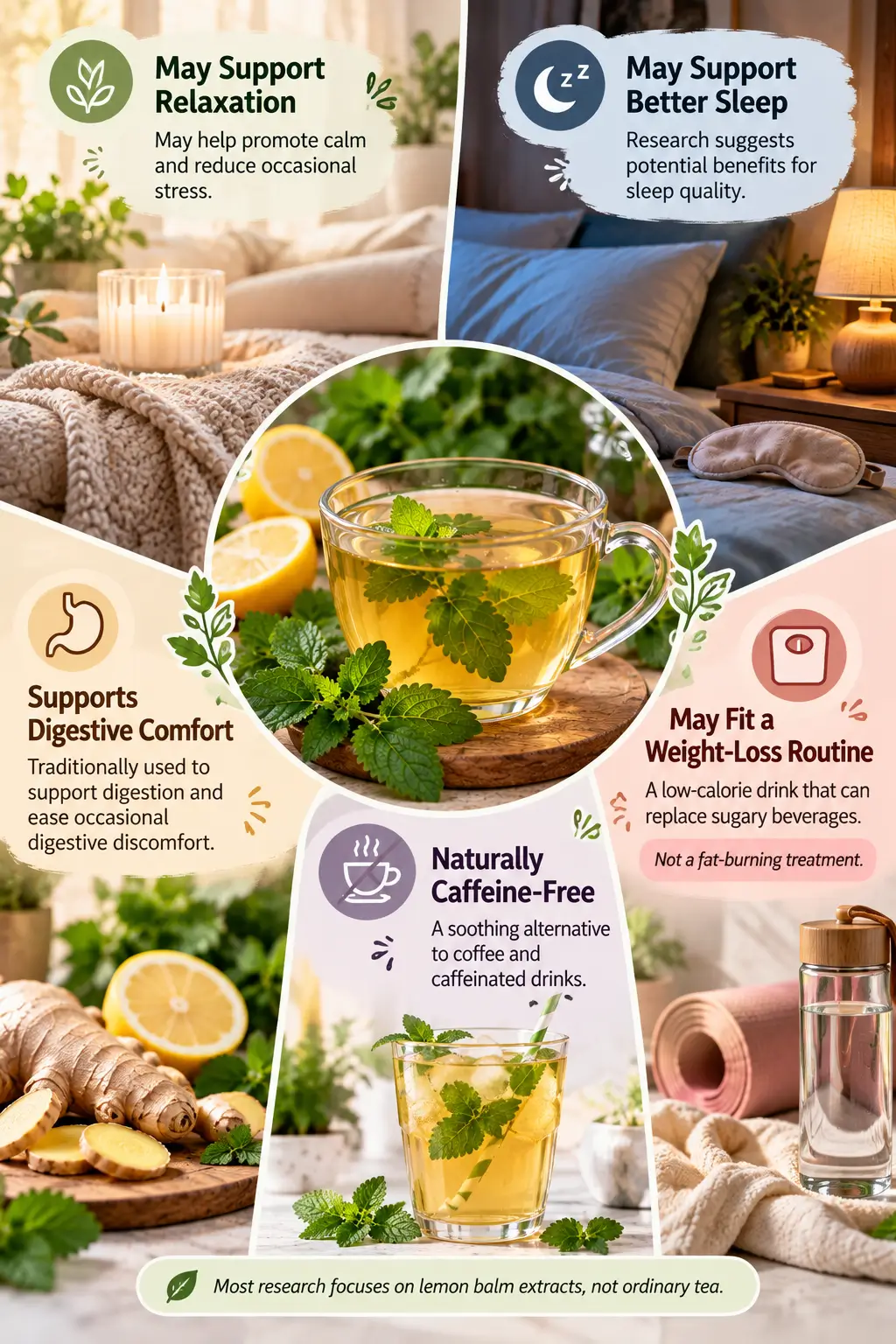
Lemon balm is better supported as a calming, gentle herb than as a weight-loss ingredient. The catch is that many modern studies used concentrated extracts or supplements, not brewed tea. So the results below should be read as “possible” for a cup of tea, not guaranteed.
| Benefit or claim | What the evidence supports |
|---|---|
| A caffeine-free drink | Well supported. Plain lemon balm leaf tea contains no caffeine, so it suits evenings and people who avoid caffeine. |
| Relaxation and stress | Long traditional use. Some human studies of specific lemon balm products report lower stress or anxiety scores, but evidence for ordinary tea is thinner. |
| Sleep | Some studies of specialized supplements report better sleep. These products are not the same as tea, so the effect of a cup is uncertain. |
| Digestive comfort | Traditionally used for mild bloating and gas. Tea is a reasonable, low-risk thing to try. |
| A low-calorie swap | If it replaces soda, juice, or a sweet coffee, it can trim calories. This depends on what you replace, not on the herb. |
| Weight loss or belly-fat burning | Not shown in human trials. |
| Appetite suppression or GLP-1 effects | Not shown in convincing human evidence. |
That makes lemon balm tea a fair choice for flavor, relaxation, or an evening routine. It is not a proven treatment for obesity, and it can’t stand in for medical weight-management care.
How Lemon Balm Tea Might Fit Into a Weight-Loss Routine
Think of this tea as a habit helper, not a treatment.
- It replaces higher-calorie drinks. A cup without honey has about 10 calories. A soda, sweet coffee, or juice has many times more. This swap is the most believable way the tea could affect your weight.
- It gives you an evening ritual. Many people snack at night out of habit or stress. A warm, caffeine-free drink can fill that slot.
- It adds fluid to your day. Drinking water or another unsweetened drink before a meal may help some people eat a little less.
- It may help you feel calmer. Stress and poor sleep can make healthy eating harder, so anything that eases them may help indirectly. That is a possibility, not something proven for weight.
The tea does not target belly fat, speed up your metabolism, or replace meals, movement, and sleep.
What the Research Actually Shows
The evidence comes in different types, and they shouldn’t be mixed together.
Traditional Use
Lemon balm has been used for centuries for stress, sleep, and mild digestive complaints. That history is real, but it isn’t proof of weight loss.
Animal Studies
Some studies in mice and rats look more promising. In one 2025 study, female mice on a high-fat diet were given lemon balm extract for six weeks. They gained less weight than mice that didn’t get it and had less fat around the intestines. A separate rat study of an extract called ALS L1023 reported lower body weight and less belly fat with no change in food intake.
These studies used small groups and concentrated extracts, often at doses far higher than a person would get from tea. Results in animals often don’t carry over to people. Until they are repeated in humans, they are a reason for more research, not a reason to expect weight loss from a mug.
Human Studies
Human research is limited, and none of it proves weight loss. This table shows what each study used, what it measured, and why it can’t be stretched into a weight-loss claim.
| Study | Participants | Form used | What was measured | Weight-loss result | Key limitation |
|---|---|---|---|---|---|
| Safari et al., 2023 (randomized, placebo-controlled) | 60 adults with type 2 diabetes and depression symptoms; 44 finished the 12 weeks | 700 mg/day of a hydroalcoholic extract | Depression, anxiety, sleep, blood sugar, inflammation, weight, BMI, waist-to-hip ratio | No meaningful difference from placebo in weight, BMI, or waist-to-hip ratio | An extract, not tea, in a specific patient group |
| Kheirkhah et al., 2021 (randomized, open-label) | 60 adults with a heart rhythm condition (premature ventricular contractions) | Tea: 2 g dried leaves in 250 mL hot water, twice a day for 12 weeks | Extra heartbeats, blood sugar, blood fats | Not a weight-loss result | Weight loss was not the outcome; the control group got lifestyle advice only, and the trial was not blinded |
| Systematic review and meta-analysis of clinical trials, 2021 | Adults in the trials included in the review | Various lemon balm preparations | Anxiety and depression | No weight-loss conclusion | Results varied widely between trials; mood scores can’t show fat loss |
| Randomized crossover trial, 2024 | 30 adults | 400 mg/night of a specialized lemon balm supplement, taken as two tablets | Sleep quality and sleep patterns | No weight-loss outcome | A product designed for better absorption, so not equal to tea |
| Mazzola et al., 2026 (secondary analysis) | A subgroup of 12 people | 400 mg/day of a lemon balm extract formulated with phospholipids, for 3 weeks | Saliva cortisol, sleep, mood | No weight-loss outcome | Very small subgroup; a supplement, not tea |
| Review of five trials | People with diabetes, high cholesterol, fatty liver, or heart disease | Supplements, 700–3,000 mg a day for 8–24 weeks | Cholesterol, triglycerides, blood sugar | Not about weight | Concentrated supplements and blood markers, not weight |
The pattern is clear. The better human evidence covers selected mood, sleep, and blood-marker outcomes. It does not show fat loss.
Tea vs. Extracts
A cup of tea is not the same as a capsule or tincture. Extracts pack much more of the plant’s compounds into each dose, and some are engineered for better absorption. Results from a 700 mg extract can’t be assumed for a mug of tea. The same goes for safety. Supplements need their own caution, so follow the label and ask a pharmacist or doctor before using them.
Why Is Lemon Balm Tea Trending for Weight Loss?
Several separate ideas have been stitched together online:
- Stress can change how and what people eat.
- Poor sleep can make healthy habits harder to keep.
- Lemon balm has some calming research.
- GLP-1 medicines like Ozempic reduce appetite and body weight.
Each idea has some truth on its own. The trouble is the jump from one to the next. An herb that may ease stress is not the same as an herb that causes weight loss, and calling it a “natural Ozempic” suggests a drug-like effect nobody has shown.
Interest in the herb jumped after social media posts began using that label. Trends like this spread fast because they offer a simple, cheap, natural answer to a hard problem. Knowing which link in the chain is missing makes them easier to judge.
Stress, Cortisol, and Emotional Eating
Stress can change food choices for some people. That is why this is the most common reason lemon balm gets linked to weight, and also where claims tend to get overstated.
What studies suggest about stress. Some human studies report lower anxiety scores with lemon balm products. A review of trials pooled these results, but it also noted that the trials differed a lot, and the reviewers called for better-quality studies. Some individual trials found improvements in stress scores with particular supplements.
What we know about cortisol. Cortisol is a stress hormone, and it gets blamed for belly fat online. The lemon balm evidence here is narrow. One small 2026 analysis followed 12 people taking a specialized extract for three weeks and found their average saliva cortisol fell. It used a supplement, not tea, and it measured no change in weight.
What this doesn’t show. Neither finding shows that ordinary lemon balm tea lowers cortisol. Neither shows that lowering cortisol with lemon balm leads to fat loss.
A reasonable way to think about it. If a calm, caffeine-free ritual helps you skip a stress snack, that is a real habit benefit. The believable chain is: possible stress relief, then easier healthy habits. It is not: lower cortisol, then automatic fat loss.
Can Better Sleep Help Weight Management?
Sleep affects appetite, energy, food choices, and how well you stick to routines. So it matters for weight management. But that doesn’t turn every sleep aid into a weight-loss tool.
One 2024 crossover study reported better insomnia scores and other sleep measures after people took a specially engineered lemon balm supplement in the evening. Participants took two 200 mg tablets. The product was designed to help the body absorb the plant’s compounds. That is a very different thing from a mug of dried-leaf tea, which may not give the same dose, absorption, or effect.
This was also a sleep study, not a weight-loss study. Even if someone sleeps better with lemon balm, that doesn’t show the herb causes fat loss. If you want to try the tea for winding down, treat it as a calming routine. Keep the room dark, cut screens before bed, and give it a few weeks before judging.
Does Lemon Balm Suppress Appetite or Work Like Ozempic?
No convincing human evidence shows that lemon balm tea suppresses appetite in a meaningful way or causes weight loss through GLP-1.
The “Natural Ozempic” Claim
Some viral videos claimed lemon balm beat the drug. No peer-reviewed research supports that. Ozempic and Wegovy contain semaglutide, a prescription drug that activates the GLP-1 receptor, a hormone target that helps control appetite and blood sugar. It has been tested in large clinical programs that measured body weight. Tirzepatide (Mounjaro, Zepbound) works on GLP-1 and a second hormone.
Lemon balm is an herb with many plant compounds. Human studies of it have looked at mood, stress, sleep, blood sugar, and blood fats. None has shown that it activates GLP-1 the way these drugs do, and none has compared it to them. Similar claims exist for other home drinks that supposedly “activate GLP-1.” Food and herbal ingredients should not be treated as equal to prescription medicines. If you take a prescribed medicine, don’t stop or swap it for herbal tea without talking to your doctor.
Does Lemon Balm Tea Burn Belly Fat?
No. No drink or herb can target fat in one spot. Your body loses fat overall when you regularly eat fewer calories than you burn. Where it comes off first depends on genetics, age, and hormones. Some teas promise fast belly fat loss. Quick changes like that usually come from water loss or less bloating, not fat loss. What has better support:
- A modest calorie deficit
- Protein and fiber at most meals
- Strength training and daily walking
- Seven to nine hours of sleep
Best Time to Drink Lemon Balm Tea
No time of day has been shown to burn more fat. Pick the time that fits your routine.
- Evening: Lemon balm is caffeine-free and traditionally used to unwind. Some studies of concentrated supplements also focused on evening use.
- Before a meal: A warm drink adds volume and may help you slow down.
- Afternoon: It can stand in for a sweet snack or sugary drink.
Treat this as a relaxation or routine choice, not a metabolic trick. If you swap a soda, sweet coffee, or evening drink for this tea, the calorie difference is the more believable reason for any change on the scale.
How Much Lemon Balm Tea Can You Drink?
No dose has been validated for weight loss.
Traditional herbal guidance for adults and teens over 12 is 1.5 to 4.5 grams of dried leaf in about 150 mL of hot water, one to three times a day. That is guidance for stress, sleep, and mild digestive upset, not for weight. It also isn’t a suggestion to drink three strong cups for weight loss. One tea trial used 2 grams of dried leaves in 250 mL of water twice a day, but it looked at heart and blood markers.
Start with one cup a day and see how you feel. A stronger brew doesn’t mean a stronger effect. Extracts, tinctures, and capsules are a different matter, because their doses are much higher and vary by product. Follow the label and ask a pharmacist or doctor.
Other Ways to Use Lemon Balm
- Lemon balm and green tea: Brew 1 tablespoon of lemon balm with 1 teaspoon of green tea leaves for 5 to 7 minutes. It adds a little caffeine, so keep it to the morning or afternoon. Use decaf green tea if you’re sensitive to caffeine.
- Lemon balm and peppermint: Steep a tablespoon of lemon balm with a few peppermint leaves for 7 to 10 minutes. It makes a nice after-dinner cup. Skip it if peppermint worsens your heartburn.
- Infused water: Add 10 to 12 lemon balm leaves, half a sliced cucumber, and half a sliced lemon to 4 cups of cold water. Chill for at least 2 hours, or overnight for more flavor. It’s nearly calorie-free and makes drinking water more fun.
- Smoothies, salads, and yogurt: Blend 5 or 6 leaves into a green smoothie, chop some into a salad, or stir them into Greek yogurt with berries. The flavor is strong, so start small. The protein and fiber in those foods, not the herb, are what keep you full.
- Supplements: Capsules, tinctures, and powders are much more concentrated than tea, and most trials used them at 350 to 3,000 mg a day. Those studies looked at things like mood, cholesterol, and blood sugar, not weight. Supplements aren’t reviewed for effectiveness before sale, so look for third-party testing (such as USP or NSF) and don’t combine several lemon balm products. Tea is the gentler place to start.
Lemon Balm Tea vs. Other Weight-Loss Teas
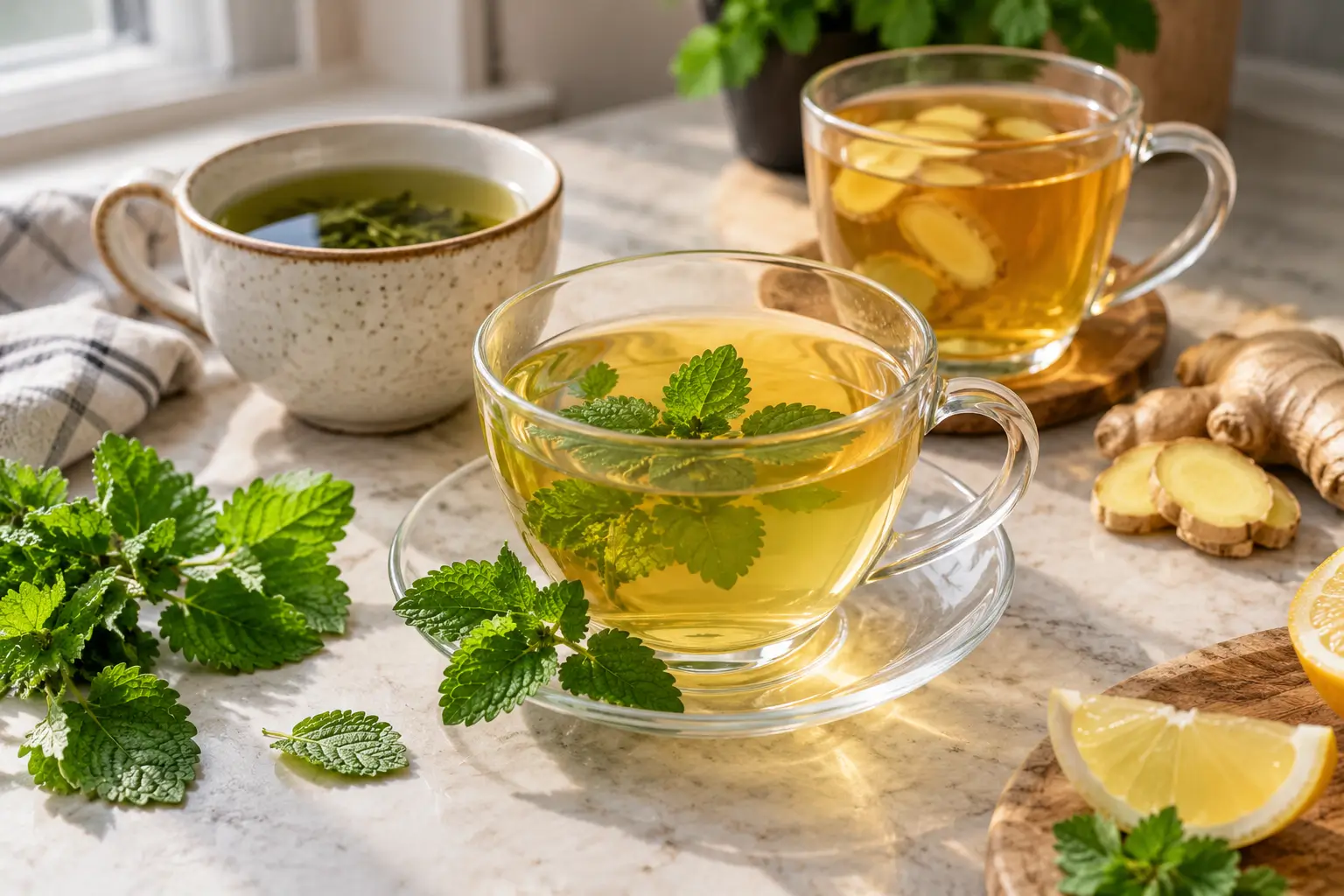
Lemon balm’s most realistic role is a caffeine-free drink you enjoy, not a proven fat-loss tea. Some other teas have been studied more directly for metabolism, body weight, or blood markers. Even the better-studied ones tend to show small effects at best, and none is a substitute for weight-loss medicine.
| Tea | Caffeine | Main reason people drink it | Weight-loss evidence |
|---|---|---|---|
| Lemon balm | None | Relaxation, evening routine | No human trials showing weight loss |
| Green tea | Yes | Energy, antioxidants | Studied more often for metabolism and weight; effects are modest at best |
| Peppermint | None | Digestive comfort, flavor | No good evidence of weight loss |
| Chamomile | None | Relaxation, bedtime | No good evidence of weight loss |
| Hibiscus | None | Tart flavor, blood pressure research | Limited and mixed |
If you want a warm drink with no caffeine, lemon balm, peppermint, and chamomile are all reasonable. If you want a tea with more research behind its metabolic effects, green tea is the usual place to look, though it contains caffeine and still isn’t a fat burner. In every case, what you drink matters less than what it replaces.
What to Expect After a Week
Expect a tasty routine and, if you swap out sugary drinks, a few fewer calories. Don’t expect noticeable fat loss. If the scale moves, the most likely reason is that you replaced soda or juice with the tea. Some people also feel less bloated. The lemon in this recipe adds very little, and lemon water has no proven weight-loss edge over plain water.
Be careful with “lemon detox” claims. One well-known study did show weight loss, but participants lived on about 500 calories a day of lemon juice, syrup, and cayenne. That is starvation-level eating, not proof that lemon burns fat.
Lemon juice is also acidic. If you drink it often, use a straw, rinse with plain water afterward, and wait about 30 minutes before brushing your teeth. To see whether the tea helps you at all, give it about a month. Notice your sleep, cravings, and evening snacking.
Safety and Side Effects
Lemon balm is generally well tolerated in food and tea amounts. “Natural” doesn’t mean it suits everyone, though. Possible side effects include nausea, stomach pain, dizziness, headache, and drowsiness. Allergic reactions such as rash are rare. If you feel unwell, stop drinking it.
Lemon balm can make some people sleepy, so be careful before driving or using machinery until you know how it affects you.
Who Should Be Careful
Talk to a doctor or pharmacist first if you:
- Are pregnant or breastfeeding. Safety hasn’t been established, and herbal authorities advise against medicinal use during pregnancy and breastfeeding.
- Have a thyroid condition or take thyroid medicine. Lab and animal research suggests some extracts may affect thyroid hormone signaling. Whether this matters in people is unknown, so regular or concentrated use is worth discussing with your doctor.
- Take sedatives or sleep medicine. Lemon balm may add to drowsiness. Formal interaction data is limited, which is a reason for caution, not proof of a problem.
- Take diabetes medicine. Some research links lemon balm to lower blood sugar.
- Have surgery coming up. Herbs can affect sedation, so mention it to your surgeon.
- Have reacted to lemon balm before. Avoid it if you have had an allergic reaction.
Children shouldn’t take lemon balm supplements without medical advice. Check labels on store-bought blends, since some contain caffeine or other herbs. A cup of leaf tea and a concentrated extract are not the same, and safety findings for one don’t automatically apply to the other.
Frequently Asked Questions
Does lemon balm help you lose weight?
Human studies haven’t shown that it does. It can be a useful low-calorie drink, but it isn’t a proven weight-loss aid. In one randomized trial, a 700 mg extract made no meaningful difference to weight, BMI, or waist-to-hip ratio compared with placebo.
Does lemon balm tea burn belly fat?
No. No human study shows that lemon balm tea burns belly fat, and no drink can target fat in one spot. Fast “belly fat” results from teas usually reflect water loss or less bloating.
Is lemon balm nature’s Ozempic?
No. Semaglutide is a prescription GLP-1 drug with large clinical trials behind it. Lemon balm has not been shown to activate GLP-1 or to act like the drug.
When should I drink lemon balm tea for weight loss?
There is no proven best time. Evening is popular because it’s caffeine-free and relaxing. Before a meal or in place of an afternoon sweet drink can also work. Any benefit is more likely from the calories you skip than from the timing.
Can I drink lemon balm tea every day?
Traditional guidance includes daily use for adults, but there is no set daily dose for weight loss. Start with one cup and see how you feel. Check with your doctor first if you are pregnant, breastfeeding, have a thyroid condition, or take medicine.
How do you make lemon balm tea?
Put ¼ cup of fresh leaves (or 1 tablespoon dried) in a mug with a grated piece of ginger. Pour over 1 cup of hot water, cover, and steep for 10 minutes. Strain, then add lemon juice and, if you like, a little honey.
Can you make lemon balm tea with fresh leaves?
Yes. Fresh leaves work very well. Use about ¼ cup, loosely packed, per cup of hot water. Bruise them gently first to release more flavor.
Is fresh or dried lemon balm better for tea?
Both work. Fresh leaves taste brighter and lighter. Dried leaves are handier year-round and taste deeper. Use 1 tablespoon of dried in place of ¼ cup of fresh. Neither has been shown to help weight loss more.
How long should lemon balm tea steep?
About 10 minutes, covered. Covering keeps more of the aroma in the cup.
Does lemon balm tea have caffeine?
Plain lemon balm tea does not. Check the label on blends, since some contain caffeine.
Can you drink lemon balm tea iced?
Yes. Brew it hot, let it cool, and serve it over ice. Skip the honey to keep the calories low.
Does lemon balm tea help with sleep?
It has a long history as a relaxing herb, and some studies of specialized supplements report better sleep. Evidence for ordinary tea is weaker, so it’s best seen as a calming evening habit rather than a proven sleep aid.
Does lemon balm lower cortisol?
The evidence is preliminary. One small analysis of 12 people using a specialized extract reported lower saliva cortisol. It wasn’t a tea study, and it didn’t measure weight loss.
The Bottom Line
Lemon balm tea is a pleasant, low-calorie, caffeine-free habit, not a fat burner. Human trials haven’t shown meaningful weight loss, and the more promising weight results come from animal studies. It is not a natural Ozempic. Its best use is simple. Replace a sugary drink with it, or make it part of a calming evening routine, alongside protein-rich meals, fiber, daily movement, and good sleep. If you’re pregnant or take thyroid, sedative, or diabetes medicine, check with your doctor before making it a daily habit.
Scientific References
- Safari M, Asadi A, Aryaeian N, et al. The effects of Melissa officinalis on depression and anxiety in type 2 diabetes patients with depression: a randomized double-blinded placebo-controlled clinical trial. BMC Complementary Medicine and Therapies. 2023;23:140. doi:10.1186/s12906-023-03978-x. PMID: 37131158.
- Kheirkhah J, et al. Melissa officinalis tea favourably affects the frequency of premature ventricular beats and cardiometabolic profile among patients with premature ventricular contraction: a randomised open-label controlled trial. International Journal of Clinical Practice. 2021;75(10):e14644. doi:10.1111/ijcp.14644. PMID: 34309987.
- Mazzola G, Rondanelli M, Lazzarotti A, Misiano P, Petrangolini G, Perna S. Salivary cortisol dynamics and their relationship with sleep and mental well-being in adults receiving a phospholipid-based Melissa officinalis supplement: a secondary analysis in a subpopulation. Food & Nutrition Research. 2026;70:14023. doi:10.29219/fnr.v70.14023.

Pingback: Baking Soda Weight Loss Recipe: Does It Really Work?
Pingback: Starbucks Medicine Ball Recipe: How to Make It at Home