


Neapolitan pizza dough is a four-ingredient dough (Tipo 00 flour, cold water, sea salt, and fresh yeast) rested for hours to build flavor and a light, airy crust. The Associazione Verace Pizza Napoletana (AVPN) wrote its official protocol in 1984, and the EU protects the method as a Traditional Specialty Guaranteed food.
This guide covers what the dough is made of, how it differs from regular pizza dough, exact measurements for 500g and 1kg batches, a dry-yeast conversion, nutrition facts, and answers to the most common questions, all using simple baker’s percentages that scale to any batch size.
What Is Neapolitan Pizza Dough Made Of?
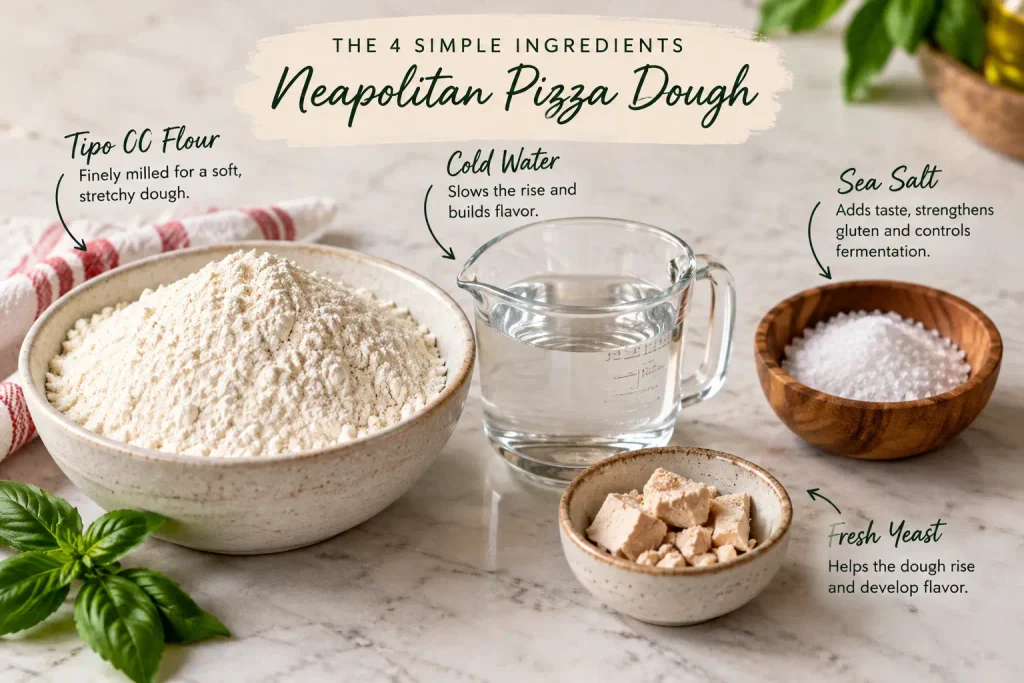
Just four ingredients: flour, water, salt, and yeast. No oil, no sugar.
- Tipo 00 flour: finely milled, giving a soft, stretchy dough. Bread flour works as a backup, but needs less water (55–60% hydration).
- Cold water: slows the rise, which builds flavor and an airy crust.
- Sea salt: adds taste, strengthens gluten, and controls fermentation.
- Fresh yeast: the traditional choice; dry yeast works at a reduced amount (see below). The AVPN standard also allows a natural sourdough starter instead.
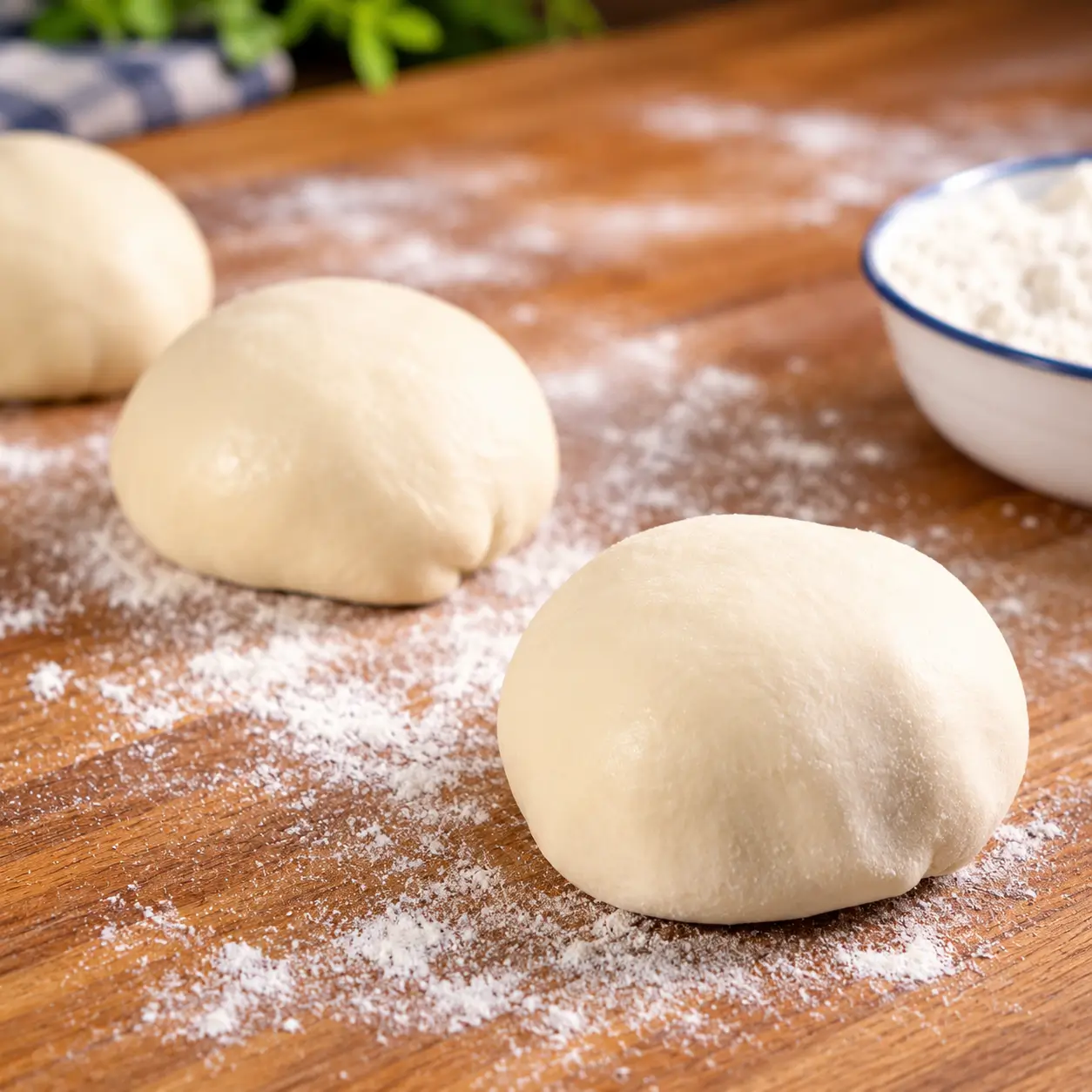
Neapolitan Pizza Dough Recipe
Ingredients
Equipment
Method
Notes
- Flour: Tipo 00 is the best choice. If you cannot find it, use regular bread flour with less water, about 55% to 60% (275g to 300g for this batch).
- Water: Use cold water for a slow rise. Warm water speeds up fermentation, and a slow rise makes a lighter, tastier crust.
- Salt: Use sea salt. Dissolve it fully in the water before adding anything else.
- Yeast: The video calls for fresh yeast. If you only have dry yeast, use half the amount (0.5g for this batch), because dry yeast is stronger.
- Scaling the recipe: Always work with percentages. For one medium pizza of about 220g, use about 131g flour, 85g water, 4g salt, and 0.26g fresh yeast. For a 1kg flour batch, use 1000g flour, 650g water, 30g salt, and 2g fresh yeast, which makes about 8 balls of 210g.
- Ball size: A medium pizza uses a dough ball of about 220g.
- Calories and cost: Both are estimates and vary by brand and location
Baker’s percentages
The standard formula is 100% flour, 65% water, 3% salt, 0.2% fresh yeast (percentages are relative to flour weight). The AVPN’s own limits, per litre of water, are 40–60g salt and 0.1–3g fresh yeast, with hydration of 55–62%. This recipe uses 65% hydration because home ovens suit a slightly wetter dough (65–70%) than a wood-fired oven does.
Weigh everything on a digital scale. Cups and spoons can’t measure 1g of yeast accurately.
Neapolitan vs. Regular Pizza Dough
| Neapolitan | Regular | |
|---|---|---|
| Ingredients | Flour, water, salt, yeast only | Often adds oil, sugar, extra yeast |
| Yeast amount | ~0.2% (tiny) | Usually higher, for a faster rise |
| Water temp | Cold (slow rise) | Often warm (fast rise) |
| Shaping | Hand-stretched only (no rolling pin) | Often rolled |
| Bake temp | ~485°C (905°F), wood-fired | Much lower, in a home oven |
| Bake time | 60–90 seconds | Several minutes |
| Result | Charred spots, puffy rim (cornicione), foldable slice | Evenly browned, sturdier crust |
Outdoor ovens like the Gozney Roccbox or Ooni Koda get close to Neapolitan heat (around 430°C) in a backyard setting.
How to Stretch Neapolitan Dough by Hand
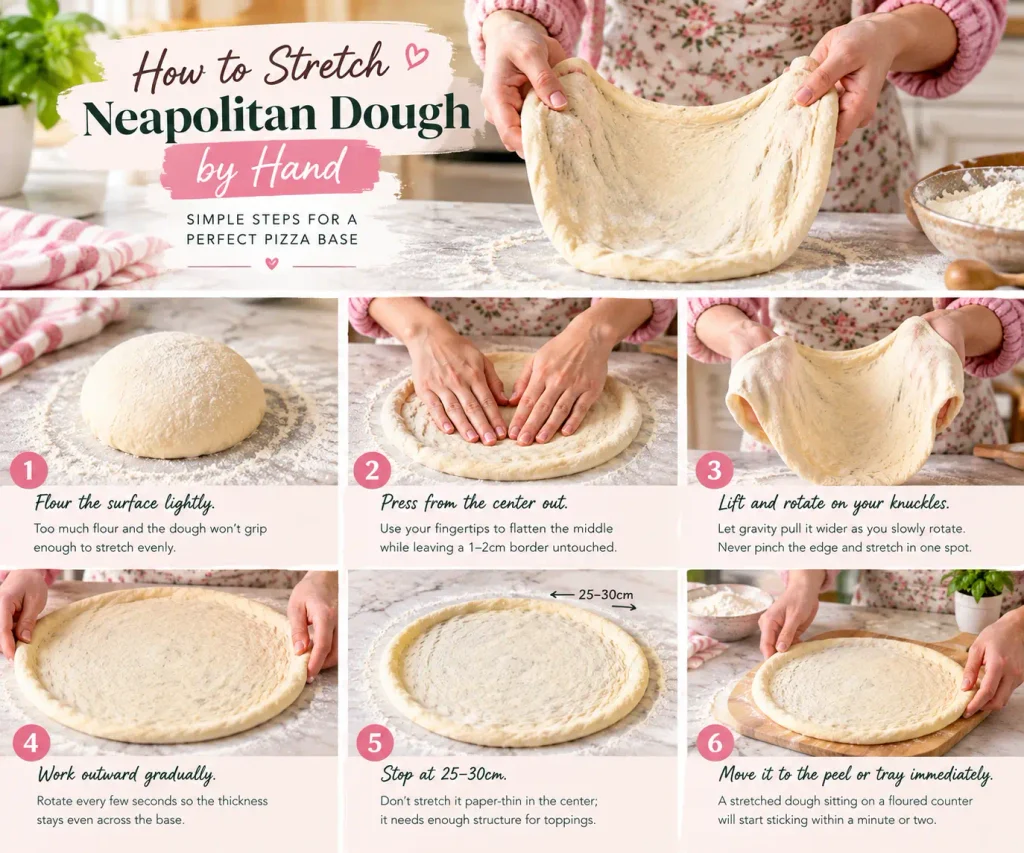
Stretching, not rolling, is what keeps the air in the rim. A rolling pin flattens out the bubbles the long rise worked to build, so this step is done entirely by hand.
- Flour the surface lightly. Too much flour and the dough won’t grip enough to stretch evenly.
- Press from the center out, using your fingertips to flatten the middle while leaving a 1–2cm border untouched. That untouched border becomes the cornicione (the puffy rim).
- Lift and rotate on your knuckles. Drape the dough over your knuckles or the backs of your hands and let gravity pull it wider as you slowly rotate it. Never pick it up by the edge and stretch with your fingers pinching in one spot; that tears the dough or makes it uneven.
- Work outward gradually, rotating every few seconds so the thickness stays even across the base.
- Stop at 25–30cm. For a home oven especially, don’t stretch it paper-thin in the center; it needs enough structure to hold toppings without tearing when it goes onto the peel or tray.
- Move it to the peel or tray immediately once shaped, since a stretched dough sitting on a floured counter will start sticking within a minute or two.
If a hole tears through, pinch it closed rather than restretching that section. It won’t be invisible, but it’ll hold the toppings.
How to Tell When Your Dough Is Ready
Two quick checks tell you more than watching the clock:
- The poke test: press a finger into the dough about 1cm deep, then release. If the dent springs back slowly and leaves a slight indent, it’s ready. If it springs back instantly, it needs more time. If it doesn’t spring back at all and just collapses, it’s over-proofed.
- The windowpane test (during kneading, not after rising): pull off a small piece of dough and gently stretch it between your fingers. If it stretches thin enough to see light through without tearing, the gluten has developed enough. If it tears quickly, keep kneading.
A dough ball that’s ready to stretch will also look visibly puffier than when it was first shaped, roughly 50% larger, with a smooth, slightly domed surface.
Scaling and Substitutions
| Want… | Flour | Water | Salt | Yeast |
|---|---|---|---|---|
| 500g batch (4 balls, ~210g) | 500g | 325g | 15g | 1g fresh |
| 1kg batch (8 balls, ~210g) | 1kg | 650g | 30g | 2g fresh |
| Single 220g ball | 131g | 85g | 4g | 0.26g fresh |
| Dry yeast instead of fresh | – | – | – | Half the fresh-yeast weight (e.g. 0.5g dry for the 500g batch). In a warm kitchen, the AVPN’s tighter ratio, one-third of the fresh weight (~0.33g), is safer. |
For a 1kg batch, mix the same way (100g flour as the salt buffer, then the rest), but consider kneading and rising it in two portions since it’s a lot to handle by hand in one go.
Same-Day vs. Cold Fermentation (24–72 Hours)
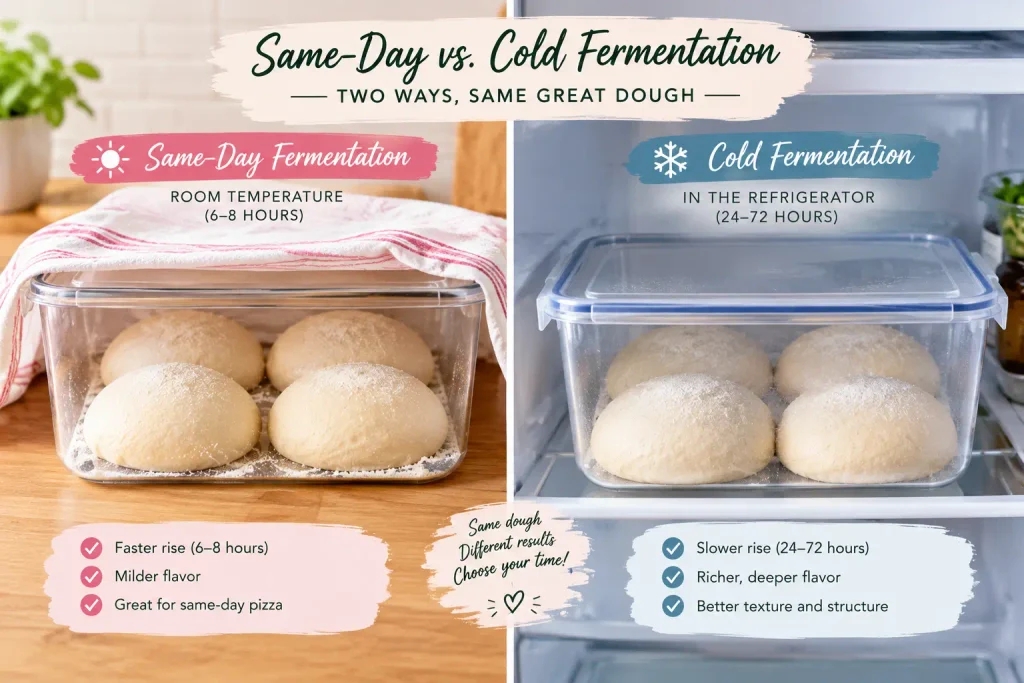
There’s no real shortcut to Neapolitan dough. Warm water and extra yeast will speed up the rise, but at the cost of the flavor and airy crumb the slow rise creates. The same-day method (2 hours resting, then 4–6 hours rising) takes 6–8 hours total but only about 30 minutes of hands-on work; mix in the morning, bake in the evening.
Cold fermentation, resting the shaped balls in the fridge for 24–72 hours instead of at room temperature, builds deeper flavor by slowing the yeast even further. If you go this route:
- Use a stronger flour (Caputo Cuoco suits 48–72 hours; Caputo Pizzeria suits 8–24 hours).
- Cut the yeast further than the same-day recipe, around 0.3g instant dry yeast per kilo of flour for a 48-hour ferment, less for 72 hours.
- Keep salt at 3% and hydration at 60–65%.
- Pull the dough balls from the fridge at least 3 hours before baking so they come to room temperature.
Use same-day for convenience, cold fermentation if you can plan a few days ahead. The mixing method is identical either way.
Baking in a Home Oven

A wood-fired Neapolitan oven hits 840–900°F; a home oven tops out around 500–550°F on a baking steel or stone. That gap means:
- Preheat the steel or stone for 45–60 minutes so it holds enough heat.
- Stretch by hand; never use a rolling pin, which pushes out the air that forms the puffy rim.
- Expect a bake time of roughly 7–8 minutes, not 60–90 seconds.
- This 65%-hydration dough suits a home oven bake. If you want the real 60–90 second bake, you’ll need an outdoor oven (Roccbox, Ooni Koda, etc.).
Troubleshooting
- Dough is sticky: Normal at first. 10–20 minutes of kneading fixes it. Don’t add extra flour; it throws off the 65% hydration.
- Dough won’t rise: Check the yeast is fresh and the room isn’t too cold.
- Dense crust: Usually means the dough needed more time to rise.
- Pale crust: The oven or steel wasn’t hot enough before baking.
- General rule: Never let salt touch yeast directly. The flour buffer in the mixing step exists for exactly this reason.
Nutrition (Per Dough Ball, ~210g, Dough Only)
| Nutrient | Amount | % Daily Value* |
|---|---|---|
| Calories | ~465 | 23% |
| Total Fat | ~2.5g | 3% |
| Saturated Fat | ~0.4g | 2% |
| Sodium | ~1,450mg | 63% |
| Total Carbohydrate | ~95g | 35% |
| Dietary Fiber | ~3.4g | 12% |
| Total Sugars | ~0.4g | n/a |
| Protein | ~13g | 26% |
Based on a 2,000-calorie diet. These are rough estimates calculated from the recipe’s ingredients, not lab-tested values; actual numbers shift with your specific flour brand, so check your bag’s label if precision matters. Sodium runs high because the recipe follows the traditional 3% salt ratio; toppings (tomatoes, mozzarella, olive oil) add more on top of this.
FAQ
Can I use bread flour instead of Tipo 00?
Yes, but drop hydration to 55–60% (275–300g water for a 500g batch). Tipo 00 gives a softer, stretchier dough because it’s milled finer, but bread flour still makes a solid pizza.
What hydration should I use?
55–65% is the normal range; this recipe uses 65% because home ovens suit a slightly wetter dough than wood-fired ovens do.
Can I skip the flour buffer step?
Not recommended. Salt in direct contact with yeast can damage it and slow fermentation.
Is a stand mixer okay instead of hand-kneading?
Not part of the traditional method (which is hand-only), but a stand mixer with a dough hook works fine if you don’t have 10–20 minutes to knead by hand. Just watch that you don’t overwork it.


Pingback: Ooni Pizza Dough Recipe for Perfect Homemade Pizza