


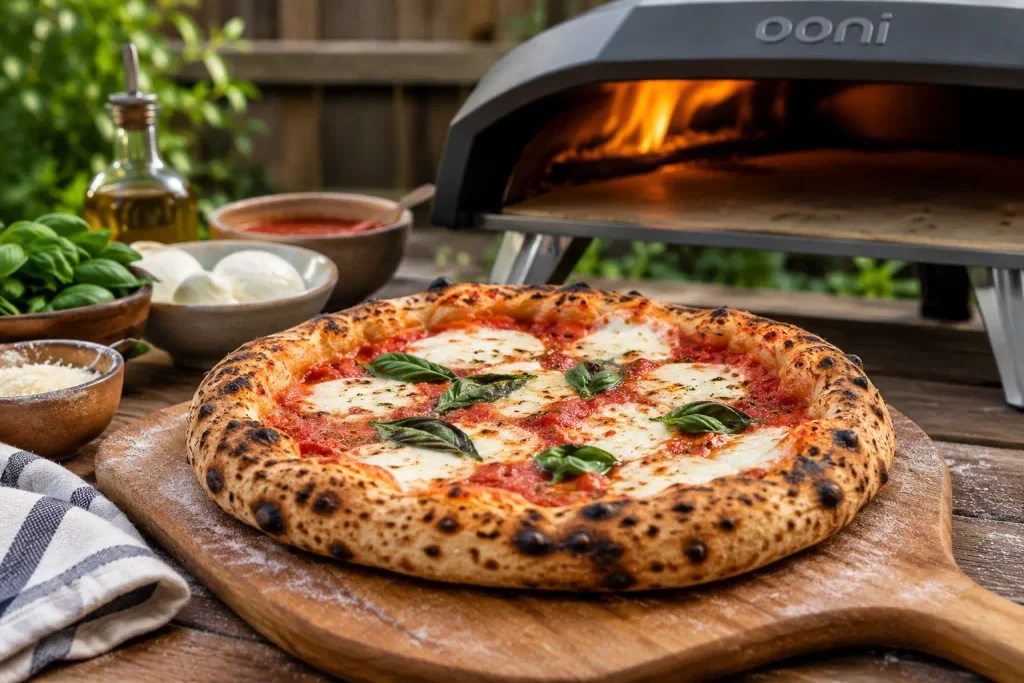
This Ooni pizza dough recipe makes a soft, chewy pizza crust with a crisp, golden edge and light char. It is made with simple ingredients and is designed to work well in the high heat of an Ooni pizza oven. The dough is easy to prepare and can be made ahead of time, which makes it great for pizza night. Once the dough has risen, you can divide it into portions, stretch each one into a thin pizza base, and add your favorite sauce, cheese, and toppings. The high heat of the Ooni helps the crust cook quickly while keeping the center soft and chewy. Whether you are making pizza for your family or having friends over, this dough gives you a great base for homemade pizza. Below, you’ll find the ingredients, step-by-step instructions, and helpful tips to get the best results from your Ooni pizza oven.
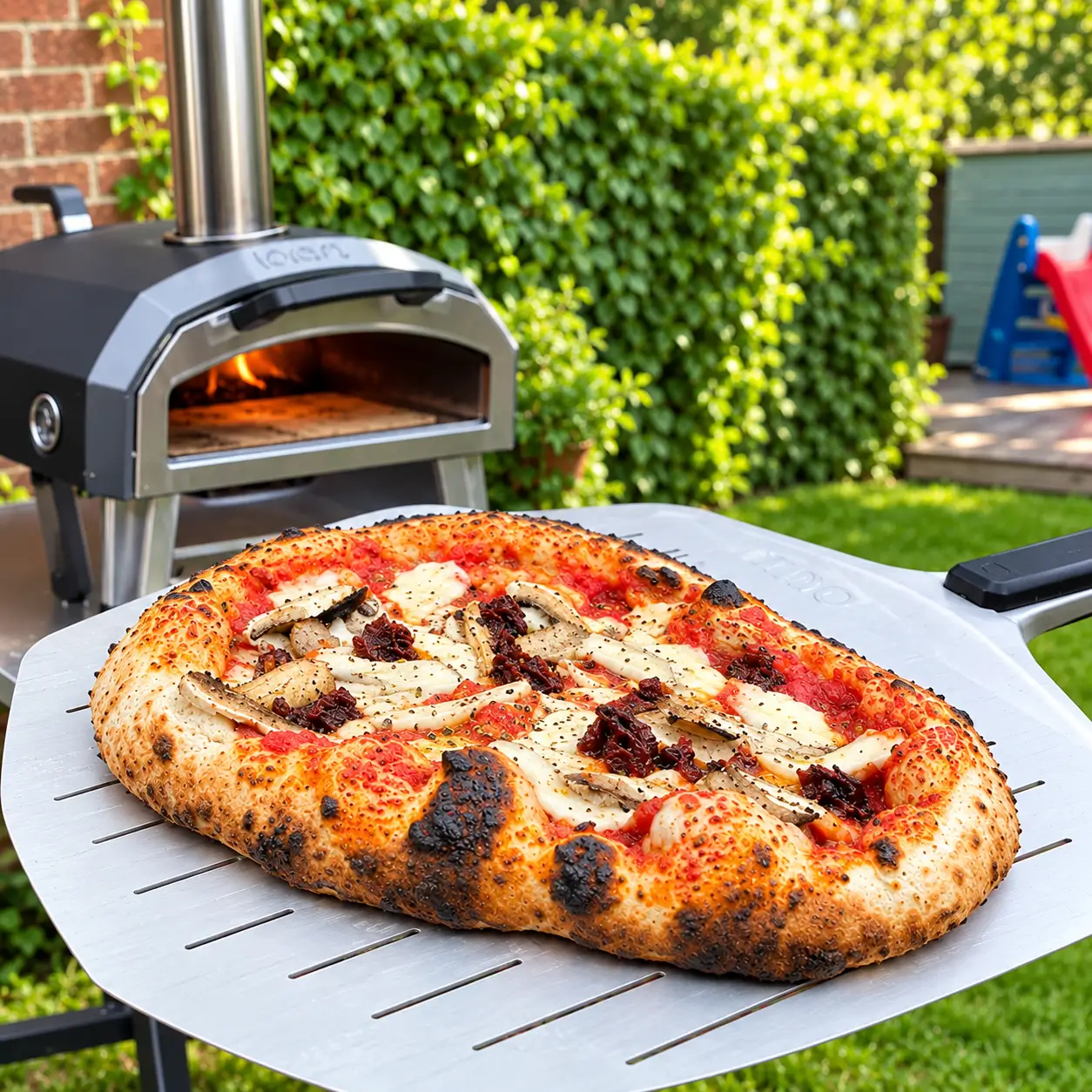
Ooni Pizza Dough Recipe (62% Hydration, 24-Hour Cold Ferment)
Ingredients
Equipment
Method
Notes
- Pizza size: One 270 g ball makes a thicker-crust 14-inch pizza or a thin-crust 16-inch pizza.
- Oven heat: The video says this suits ovens running around 400°C (roughly 750 to 850°F), such as Ooni ovens.
- Sticky dough: On a humid day the dough may feel stickier than usual. The short rest in step 4 fixes it.
- Fresh yeast: Use 2 g in place of 1 g of dry yeast. The creator prefers fresh.
- Hand mixing: It’s the dough’s consistency that matters, not the exact minutes.
- Launch tip: Use enough semolina under the dough. The creator’s pizza came out oval because he skimped on it.
What Type of Flour Is Best for an Ooni Pizza Oven?
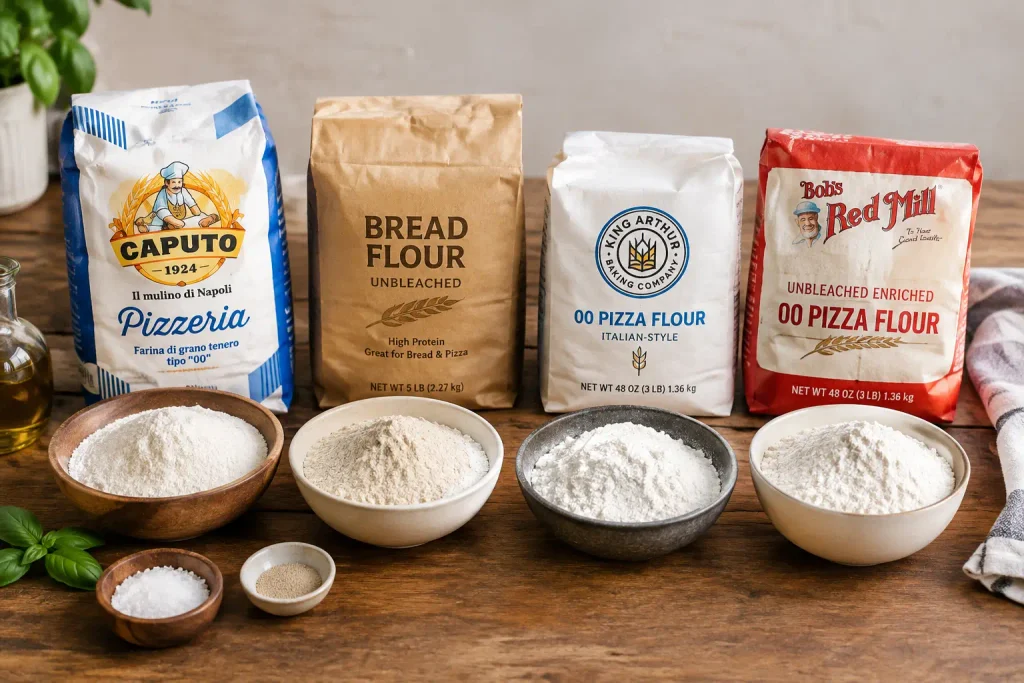
Unmalted Italian 00 flour, such as Caputo Pizzeria, is best for Ooni ovens because its fine milling and low protein create a tender, extensible dough suited to a fast, very hot bake.
00 Flour
00 flour refers to how finely Italian mills grind it, not its protein level, and that fine grind creates a smooth, stretchy dough that thins out without tearing. Ooni’s own flour guide names 00 flour as its pick for high heat, short cook Neapolitan dough, and notes its low protein does not suit every recipe. Popular options include Caputo Pizzeria, Caputo Chef’s Flour, King Arthur 00 Pizza Flour, and Bob’s Red Mill 00. Caputo Pizzeria is unmalted, which browns evenly in a 450°C Ooni but can look pale in a cooler home oven below 290°C. Molino Dallagiovanna also makes a well regarded 00 flour used by many pizzerias for its balance of stretch and structure.
Bread Flour and All Purpose Flour
Bread flour has higher protein (12% to 14%), which builds more gluten strength but also needs more water and a longer bake than 00 flour. All purpose flour works as a substitute but has less gluten strength than bread flour, producing a chewier, less crisp crust. If you only have bread flour, add 3% to 5% more water to compensate for its higher absorption, and expect to add 15 to 20 seconds to the bake.
Malted vs Unmalted Flour
Malted flour, which contains added malted barley, browns faster than unmalted flour, so it suits slower home oven bakes. Unmalted flour, like Caputo Pizzeria, browns more slowly and evenly, which fits the brief, intense heat of an Ooni. Using malted flour at 450°C risks burnt spots before the crumb finishes cooking. A pale, uneven crust in an Ooni is not caused by malted flour; it comes from unmalted flour baked on a stone that has not fully preheated (see Troubleshooting).
Gluten Free Options
A 1:1 gluten free blend with added xanthan gum can produce a workable Ooni dough, but it is stickier, tears more easily, and bakes best pressed onto parchment rather than stretched freehand.
Flour Comparison
| Flour | Protein | Best For | Behavior at High Heat |
|---|---|---|---|
| Caputo 00 Pizzeria | Low, unmalted | Neapolitan, Ooni ovens | Browns evenly |
| Bread Flour | High (12–14%) | Chewier crust | Needs more water, longer bake |
| King Arthur 00 Pizza Flour | Low–medium | Neapolitan style | Similar to Caputo |
| Bob’s Red Mill 00 | Low–medium | Neapolitan substitute | Close to Caputo, widely available |
Ooni Pizza Dough Ingredients and Ratios
The core recipe uses four ingredients measured by baker’s percentage: flour is always 100%, water is 62%, salt is 3%, and yeast is a fraction of a percent.
Baker’s Percentages
620 g water against 1,000 g flour equals 62% hydration; 30 g salt equals 3%. This system scales the recipe to any batch size while keeping the same texture, and lets you adjust hydration by 1% to 2% increments to fine tune the dough.
Yeast
The base recipe uses 1 g active dry yeast (or 2 g fresh) for a 6 hour bulk proof and an 18 hour cold proof. This small amount prevents over proofing across the long fridge rest, which otherwise produces a sour taste and a slack, collapsed dough. For a same day dough, increasing yeast to about 6 g speeds the rise enough to finish bulk proof in 3 to 4 hours at warm room temperature (75°F to 80°F/24°C to 27°C).
Salt
Salt at 3% of flour weight strengthens gluten and slows fermentation so flavor develops without over rising. Mix it in the order the recipe card uses: dissolve yeast in the water first, mix in the flour, then add the salt once the dough starts to come together. Fine sea salt dissolves evenly; coarse salt can leave salty spots in the finished crust.
Oil and Sugar
The base Neapolitan formula skips oil and sugar, since Ooni’s heat alone browns the crust in under two minutes. Sugar speeds browning and risks burning at 450°C, so it belongs in home oven recipes, not Ooni ones. For a softer, more forgiving dough, add up to 20 g (2%) olive oil per 1,000 g flour, though this slightly lowers oven spring.
Water Temperature
Use cool water (~68°F/20°C) in kitchens above 75°F (24°C) to avoid over fermenting during mixing. In cooler kitchens below 64°F (18°C), use warmer water (~77°F to 80°F/25°C to 27°C) to keep yeast active. The goal is a finished dough temperature of 72°F to 75°F (22°C to 24°C) right after mixing.
Best Ooni Neapolitan Pizza Dough Recipe (24 Hour Method)
Six hours of bulk proof plus 18 hours of cold proof equals 24 hours total, the sweet spot for developing flavor while keeping the dough easy to stretch. The 18 to 48 hour cold proof window lets enzymes slowly convert starches into sugars, deepening flavor without the sourness of a much longer ferment. Never exceed 48 hours counting from the start of the bulk proof; past that point the gluten structure breaks down and the dough tears when stretched.
How to Make Ooni Pizza Dough Step by Step
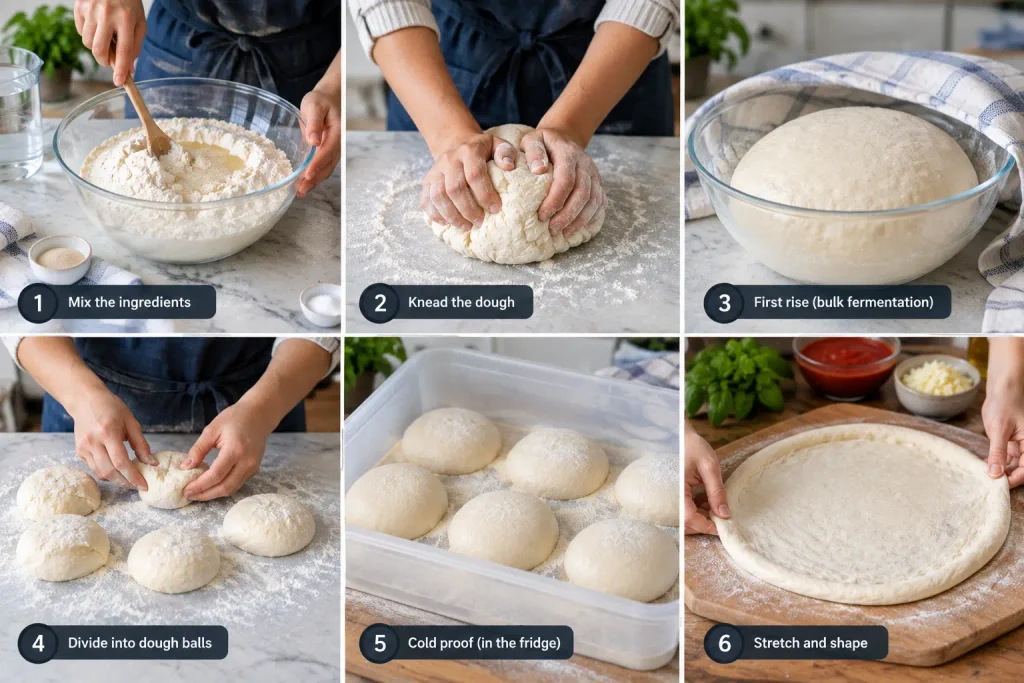
Mixing
Dissolve the yeast in the water, then mix in the flour a little at a time until a shaggy dough forms. Add the salt once the dough starts coming together, then continue mixing: 6 to 7 minutes in a stand mixer with a dough hook, or about 10 minutes by hand with a push, fold, and turn motion. The dough is ready when a small piece stretches thin enough to see light through it without tearing (the windowpane test).
Shaping and Bulk Proof
Fold the dough’s edges to the center, pinch them together, then rotate it seam side down on the counter to build surface tension. Place it in an oiled, airtight container and let it bulk proof about 6 hours at 70°F to 75°F (21°C to 24°C); above 79°F (26°C), shorten this by 1 to 2 hours. The dough should roughly double and feel airy when the container is gently shaken.
Dividing and Cold Proof
Divide the dough into six pieces of about 275 g each, weighing on a scale, and shape each into a tight ball. Move them to the fridge for 18 hours (up to 48 hours total from mixing) in individually oiled containers. About 1.5 hours before baking, pull the dough balls out to warm to room temperature, which makes stretching far easier.
Other Ooni Pizza Dough Methods

Quick Same Day Dough
Use about 6 g yeast instead of 1 g, and bulk proof at 75°F to 80°F (24°C to 27°C) for 3 to 4 hours instead of 6. Skip the cold proof and divide once the dough has roughly doubled. Keep the same 62% hydration and 3% salt; only fermentation time and yeast quantity change.
Scaling for Any Batch Size
Total dough weight equals the number of balls times about 275 g. Divide that total by 1.65 to get the flour weight, then apply 62% hydration and 3% salt to that flour weight. For very small yeast amounts, mix your full yeast dose into a measured portion of the recipe’s water and use only the fraction you need, rather than trying to weigh under 1 g directly.
| Dough Balls | Flour | Water (62%) | Salt (3%) | Yeast |
|---|---|---|---|---|
| 2 | 333 g (11.7 oz) | 207 g (7.3 oz) | 10 g | Use ⅓ of a 1 g dose, or dilute in water |
| 4 | 667 g (23.5 oz) | 414 g (14.6 oz) | 20 g | ⅔ of a 1 g dose, or dilute in water |
| 6 | 1,000 g (35.3 oz) | 620 g (21.9 oz) | 30 g | 1 g |
| 8 | 1,333 g (47 oz) | 827 g (29.2 oz) | 40 g | 1.3 g, or dilute in water |
Sourdough Ooni Pizza Dough
Use 100 g of active starter at 100% hydration (50 g flour, 50 g water within that starter), and adjust the main dough to 950 g flour and 570 g water so the totals still hit 1,000 g flour and 62% hydration overall. Bulk proof runs longer, 8 to 12 hours at room temperature, since wild yeast ferments more slowly than commercial yeast.The cold proof still runs 18 to 48 hours. Start with 50 to 100 g of starter and test from there; a stronger starter that doubles within 4 to 6 hours gives the most reliable rise.
12 Hour Shortcut
For a shorter cold proof, 12 hours in the fridge (after the 6 hour bulk proof) works as a shortcut, though flavor will be milder than the full 18 hour version. This is the same recipe, just pulled earlier, not a separate method.
Method Comparison
| Method | Total Time | Flavor | Best For |
|---|---|---|---|
| 24 Hour Neapolitan | 24–48 hours | High | Best overall texture and flavor |
| 12 Hour Shortcut | 18 hours | Moderate | Mix in the morning, bake that evening |
| Same Day | 3–4 hours | Low | Last minute pizza night |
| Sourdough | 26–36 hours | Very high | Natural fermentation fans |
| Gluten Free | Same as base | N/A | Non wheat diets; press, don’t stretch |
Dough Ball Size by Ooni Oven
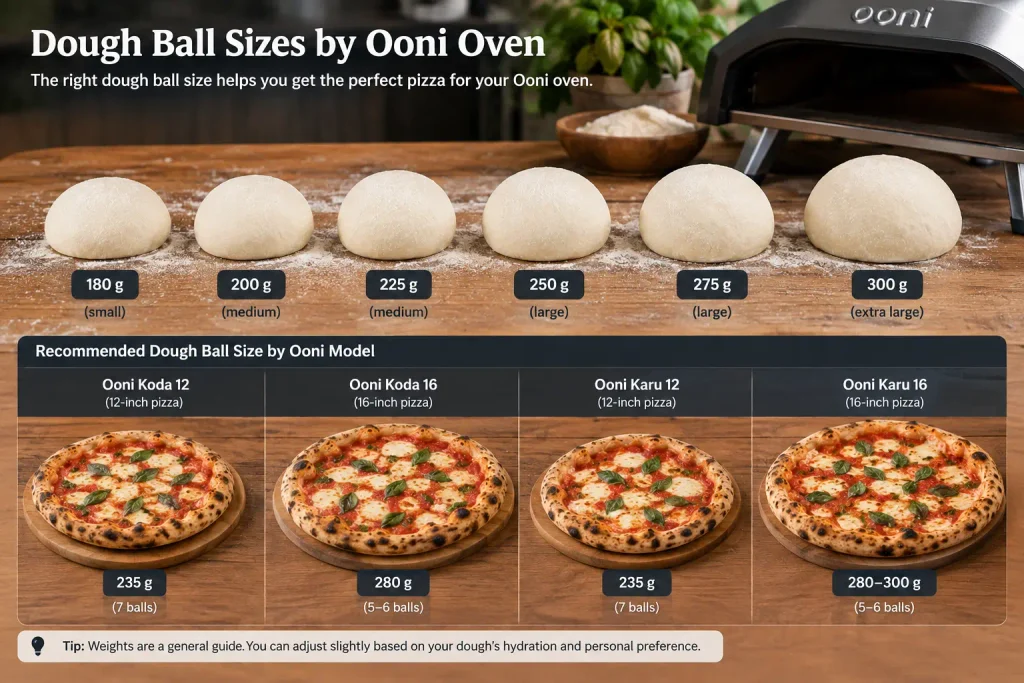
Match your dough ball to your oven’s actual stone size, not a generic “standard” most Ooni models cap out at 12 inches, only the Koda 16 and Karu 16 reach 16 inches, and the Koda 2 Max reaches 20 to 24 inches.
| Oven | Max Pizza Size | Recommended Dough Ball |
|---|---|---|
| Ooni Fyra 12 | 12 in | 235 g |
| Ooni Koda 12 | 12 in | 235 g |
| Ooni Karu 12 | 12 in | 235 g |
| Ooni Volt 12 | 12 in | 235 g |
| Ooni Koda 16 | 16 in | 275 g |
| Ooni Karu 16 | 16 in | 275 g |
| Ooni Koda 2 Max | up to 20–24 in | 400–450 g |
If you own a 12 inch oven, divide the same 1,000 g flour batch into seven balls of about 235 g each (total dough weight ≈1,650 g ÷ 7) instead of six 275 g balls.
Ooni Pizza Dough Troubleshooting
| Problem | Cause | Fix |
|---|---|---|
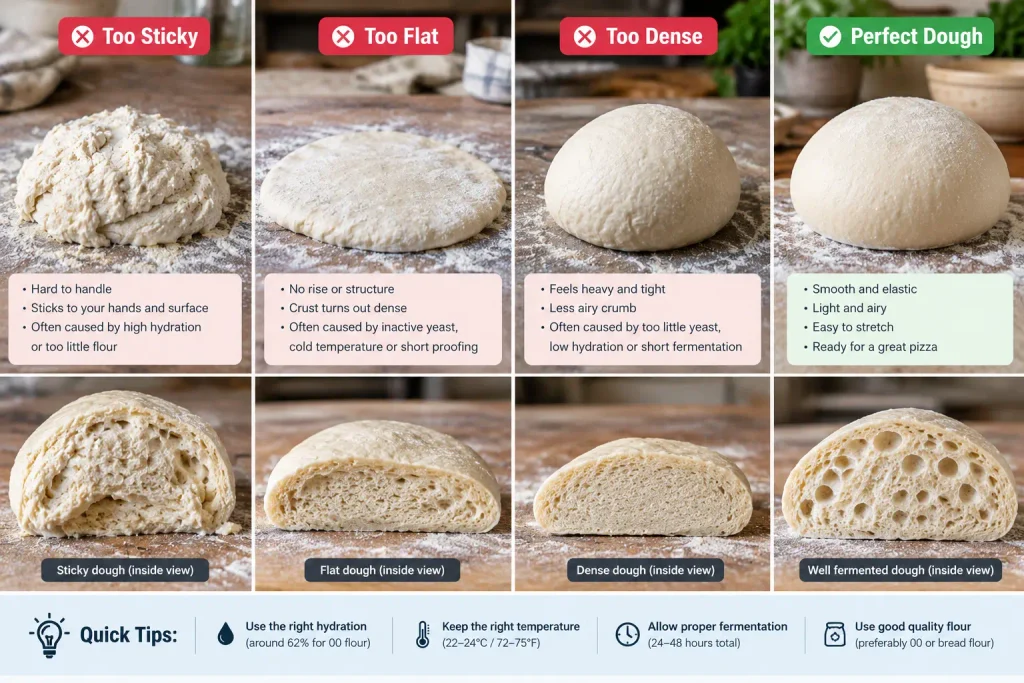
| Dough tears while stretching | Under mixed or under proofed | Mix a full 10 minutes by hand, or rest dough longer before shaping |
| Dough sticks to the peel | Not enough semolina, or sat too long before launch | Dust generously and launch within 1–2 minutes |
| Crust burns before center cooks | Hydration too low or stone too hot | Increase hydration slightly, or check stone temp with an infrared thermometer |
| Dough collapses or feels slack | Over proofed past 48 hours | Use sooner, or reduce yeast for longer proofs |
| Crust is dense, not airy | Under proofed or over worked | Extend bulk proof, or handle dough more gently when shaping |
| Pale, uneven browning | Unmalted flour on a stone that isn’t hot enough | Preheat longer and confirm stone temp before launching |
Nutrition Information
One raw 275 g dough ball, made only from flour, water, salt, and yeast with no toppings, has about 565 calories, 18 g protein, 117 g carbohydrates, and 2 g fat. These figures cover crust only; toppings like cheese, sauce, and meat add their own calories and should be counted separately.
| Nutrient | Per Dough Ball (275 g) | % Approx. Daily Value* |
|---|---|---|
| Calories | 565 kcal | 28% |
| Total Fat | 2 g | 3% |
| Sodium | 1,965 mg | 85% |
| Total Carbohydrate | 117 g | 43% |
| Dietary Fiber | 4 g | 14% |
| Total Sugars | 0 g | — |
| Protein | 18 g | 36% |
*Percent Daily Values are based on a 2,000 calorie diet and are approximate. Values are calculated from standard 00 flour, water, salt, and yeast and will vary by brand; figures marked depend on the specific flour and salt used and should be confirmed against the product label before publishing. This table reflects the crust only, not finished pizza with toppings.
FAQs
How to make Ooni pizza dough?
ix 1,000 g 00 flour, 620 g water, 30 g salt, and 1 g yeast into a smooth ball. Bulk proof 6 hours, divide into six 275 g balls, then cold proof 18 hours (24 hours total) before baking at 750°F to 850°F.
What pizza dough is best for Ooni?
A low hydration (60% to 65%) Neapolitan dough made with unmalted 00 flour performs best. It stretches thin without tearing and browns evenly during the fast 60 to 90 second bake.
What type of flour is best for making pizza in an Ooni pizza oven?
Unmalted Italian 00 flour, such as Caputo Pizzeria, is best. Its fine milling and low protein create a tender crust that browns evenly at 450°C to 500°C without burning first.
How to use Ooni pizza dough?
Warm cold dough for 1.5 hours, stretch it by hand on a semolina dusted surface, and top it quickly on a peel. Launch onto a preheated stone (750°F to 850°F) and turn every 15 to 20 seconds for 60 to 90 seconds.
Can I use all purpose flour in an Ooni?
Yes, though it has less gluten strength than bread flour and gives a chewier, less crisp crust than 00 flour.
Can I use this dough in a home oven?
Yes, but unmalted 00 flour browns poorly below 290°C, so results may look pale. For better home oven results, use a malted flour or bake at your oven’s highest setting on a preheated stone.
How long can Ooni dough stay in the fridge?
Up to 48 hours total, counting from the start of the 6 hour bulk proof. Quality is best within the first 24 to 30 hours.
What hydration is best for an Ooni?
60% to 65%. This keeps dough firm enough to launch cleanly while staying wet enough for an airy, open crumb during the fast, high heat bake.
How many dough balls does 1 kg of flour make?
About six dough balls of 275 g each, enough for six 16 inch pizzas on a Koda 16 or Karu 16, or seven smaller 235 g balls for a 12 inch oven.
Conclusion
This Ooni pizza dough recipe gives you a soft, chewy crust with a crisp edge, using only four simple ingredients. The long rise does most of the work, so the dough is easy to stretch and full of flavor. The key is to plan ahead: mix the dough a day early and let it rest in the fridge. Then let it warm up before baking, and make sure your Ooni is fully hot. Store extra dough balls in the fridge or freezer for another pizza night. Try a batch this weekend and see how your Ooni handles it.